

You download a trading app, see “$0 commissions,” and feel like you found a loophole. You didn’t. Someone earns money on every trade you place, and most beginners never learn who. If you’re asking what is a trading platform and what it really costs you, this guide gives you the straight answer: how it works, where the hidden costs sit, and what to check before you deposit a single dollar.
What Is a Trading Platform?
The Simple Definition
A trading platform is the software you use to buy and sell investments like stocks, ETFs, and options. It’s the screen where you see live prices, read charts, place orders, and track your portfolio. In the US, it comes attached to an online brokerage account, and you reach it through a mobile app, a website, or desktop software.
You never walk onto the floor of an exchange. The platform carries your instruction there and brings the result back to you.
What a Good Platform Gives You
Every solid platform covers the same core tools:
- Real-time quotes, including the bid and ask price
- Charts and technical indicators
- Order entry for market, limit, and stop orders
- Research and news feeds
- Portfolio tracking and full trade history
- Security controls, such as two-factor authentication
If a platform is missing the first three, skip it.
How a Trading Platform Works Behind the Screen
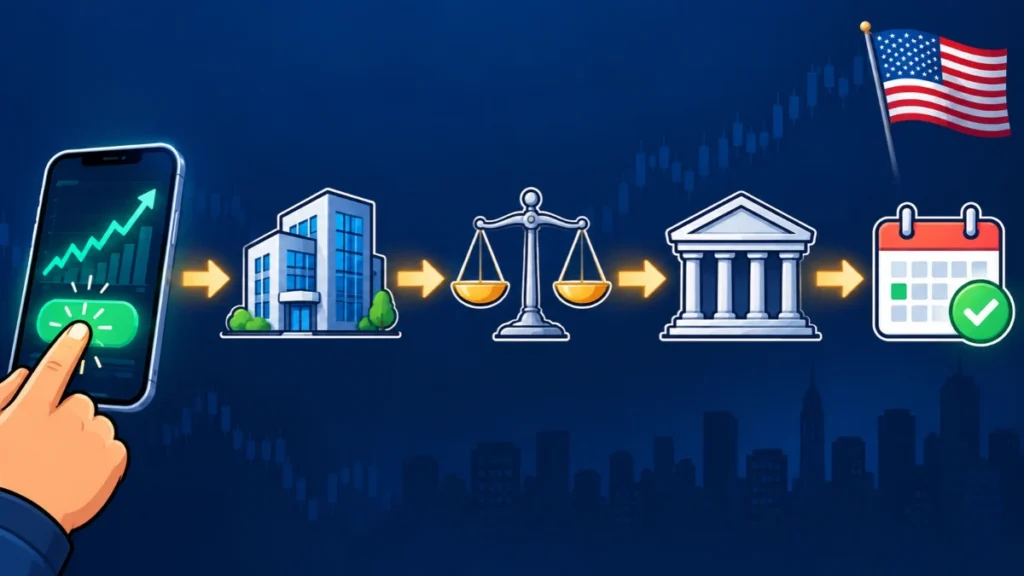
The Life of a Single Order
Say you tap “buy” on 10 shares of a stock. Here’s what happens in the next few seconds:
- Your platform sends the order to your broker.
- Your broker decides where to route it: a public exchange or a market maker.
- The order fills at or near the current quote.
- The trade settles one business day later, a standard known as T+1 that has applied to most US securities since May 2024.
You see a confirmation. Behind it sits a chain of firms, and each link in that chain is a place where money can move.
Order Types You Need to Know
Your order type controls the price you get, so learn these three before your first trade:
- Market order: buys or sells immediately at the best available price. It guarantees speed, not price.
- Limit order: buys or sells only at your price or better. It guarantees price, not execution.
- Stop order: turns into a market order once the stock hits your trigger price. The stop price is a trigger, not a guaranteed fill price, so a fast market can fill you well away from it.
A simple rule works for most beginners: when price matters, use a limit order.
Trading Platform vs Broker vs Exchange: Who Does What?
Here’s where beginners get stuck when they first ask what is a trading platform: they treat the platform, the broker, and the exchange as one thing. The trading platform vs broker confusion alone causes half the bad decisions in this space. Each has a separate job.
| Term | What it is | Its job in your trade |
|---|---|---|
| Trading platform | The app or software you use | Shows prices, takes your order, displays your portfolio |
| Broker | A regulated firm that holds your account | Holds your money and securities, routes and executes your orders |
| Exchange | A marketplace such as the NYSE or Nasdaq | Matches buyers and sellers publicly |
| Market maker | A firm that quotes prices to buy and sell | Fills orders, often off-exchange, and profits from the spread |
The platform is what you touch. The broker is who you’re paying and trusting. The exchange or market maker is where your trade lands. Once you see that split, the fee conversation makes sense.
Types of Trading Platforms
Web, Mobile, and Desktop
What is a trading platform in practice? It comes in three formats:
- Mobile apps: built for speed and simplicity. Most beginners live here.
- Web platforms: full-featured in any browser with nothing to install.
- Desktop software: heavy on charting, scanners, and custom layouts. Active traders use it.
Broker-Built vs Third-Party
Most US stock brokers build their own platform. Third-party tools, like standalone charting software, connect to your broker and add analysis on top. As a beginner, start with the platform your broker provides. Adding a second tool before you’ve placed ten trades only adds noise.
Why “Free” Isn’t Always Free
So what is a trading platform doing when it advertises $0? It’s shifting the cost somewhere you can’t see it. Commission-free trading is real. Cost-free trading isn’t. Both statements are true at once.
Payment for Order Flow
The biggest source is payment for order flow (PFOF). Your broker routes your order to a market maker, and the market maker pays the broker for the right to fill it. It funds a large share of commission-free trading in the US.
PFOF is legal and disclosed. Brokers still owe you best execution under FINRA rules, and they argue that you often get price improvement. Critics argue that routing for payment can conflict with getting you the best price. Both sides exist. What matters for you is this: your cost lives in the price you receive, not on your statement.
How Free Platforms Really Make Money
PFOF isn’t the only revenue stream. Expect a mix of these:
- Bid-ask spreads: the gap between the buy and sell price
- Interest on uninvested cash sitting in your account
- Securities lending: lending out shares you hold
- Margin interest when you borrow to trade
- Premium subscriptions for faster data and lower margin rates
- Options fees: several large brokers charge around $0.65 per contract
That answers the question how do commission-free trading apps make money: from your activity, your cash, and your borrowing.
The Fee Stack: Every Cost to Look For
Trading platform fees aren’t one number. They stack. A broker with zero commissions can still cost more than one that charges a small fee, depending on how you trade.
| Fee type | How it hits you | Who should watch it |
|---|---|---|
| Commission | Flat or per-contract charge on each order | Options and futures traders |
| Bid-ask spread | Built into your buy and sell price | Everyone, especially in thin stocks |
| Regulatory fees | Tiny charges on sales, passed through | Frequent sellers |
| Margin interest | Daily interest on borrowed money | Anyone using margin |
| Inactivity or account fees | Charged by some brokers on dormant or small accounts | Casual, low-balance investors |
| Data and platform subscriptions | Monthly fee for premium tools | Active traders |
| Transfer-out fee | Charged when you move your account to another broker | Anyone who switches later |
The headline commission is the smallest number on this page. The rows below it decide your real cost.
How to Spot Costs Before You Sign Up
Open the broker’s fee schedule, not the homepage. Search it for three items: options contract fees, margin rates, and account transfer fees. Ten minutes there tells you more than any review.
Is a Trading Platform Safe?

SIPC Protection
Reputable US brokers are SIPC members. SIPC protects you up to $500,000, including $250,000 in cash, if your broker fails and your assets go missing. It doesn’t cover market losses. If your stock drops 30%, nobody reimburses you. Confusing those two is a costly mistake.
Regulation and Account Security
Check that your broker is registered with the SEC and FINRA. FINRA’s BrokerCheck tool takes about a minute. Then protect your own side: turn on two-factor authentication, use a unique password, and never share login codes. Most account takeovers start with the user, not the platform.
What Beginners Should Know First
The $25,000 Day Trading Rule Is Gone
For 25 years, the pattern day trader rule forced margin accounts under $25,000 to limit day trades. That changed on June 4, 2026, when FINRA’s amended Rule 4210 took effect. The PDT label and the $25,000 minimum are gone, replaced by real-time intraday margin standards. A margin account still needs a minimum of $2,000.
Your broker sets its own implementation details, so read its margin policy. Fewer restrictions also means fewer guardrails, and that’s a risk, not a gift.
Start With Paper Trading
Many platforms offer paper trading, a simulated account with fake money and real prices. Use it for two weeks. Place market orders, limit orders, and stops. Learn where the buttons are while a mistake costs nothing.
The Mistakes That Cost New Traders the Most
- Overtrading: every extra trade adds spread and tax friction
- Market orders in thin stocks: you take whatever price appears
- Ignoring fees because the app said “free”
- Trading on emotion, which does the most damage of all
Your biggest risk isn’t the app. It’s how you react to a red screen. We break that down in our guide to the psychology of investing.
How to Choose Your First Trading Platform

Before you compare names, answer one question honestly: what is a trading platform supposed to do for you? A long-term investor needs low costs and solid ETF access. An active trader needs speed and charting. Match the tool to the job.
Run every platform through this checklist:
- SIPC member and registered with the SEC and FINRA
- Clear fee schedule with no surprises
- $0 account minimum and fractional shares if you’re starting small
- Easy interface you can use without a manual
- Paper trading or education built in
- Responsive support when something breaks
When you’re ready to compare specific names, use our breakdown of the best trading platforms for beginners.
FAQ
What is a trading platform in simple terms?
It’s the app or website you use to buy and sell investments through a broker. It shows prices, takes your orders, and tracks your portfolio.
Are trading platforms really free?
Commissions on stocks and ETFs are often $0. The platform still earns through payment for order flow, spreads, interest on your cash, and paid tiers. Free describes the commission, not the cost.
Is a trading platform the same as a broker?
No. The broker is the regulated firm that holds your account and executes orders. The platform is the software you use to reach it.
How much money do I need to start?
Many major US brokers have $0 minimums, and fractional shares let you begin with a few dollars. Start with an amount you can afford to lose while you learn.
Is it safe to use a trading app?
It’s safe when your broker is SIPC-covered and regulated, and you’ve turned on two-factor authentication. Safety covers the firm failing. It doesn’t cover your investments losing value.
Conclusion
A trading platform is your window into the market and a business that earns from how you use it. You now know how an order travels, why “free” carries a price, what the fee stack looks like, and which safety checks matter. Pick a regulated broker, read the fee schedule, practice on paper, and place your first trade with a limit order. Know the price of the tool before you trust it with your money.
Disclaimer: This article is for educational purposes only and isn’t financial, investment, or legal advice. Investing involves risk, including the loss of principal. Fees, rules, and account terms change, so verify current details with your broker and consult a licensed professional before making decisions.
About the Author – Abhishek Chouhan
Abhishek Chouhan is a Global Finance Analyst and Market Researcher with over 15 years of experience studying stock markets, investor behavior, and long-term wealth cycles across the US, Europe, and Asia. He is the founder of MoneyUncut.com, a global financial intelligence platform focused on decoding market psychology, economic trends, and how human behavior shapes financial outcomes.