

You did everything right. Strong reviews, years of loyalty, never the person who dropped the ball. Then a calendar invite titled “quick sync” ends it all.
In every job market during recession, the people who go first are rarely the ones workers expect, and the real pattern looks nothing like office gossip.
This guide shows you who gets cut first, which jobs hold, and what to do before the cuts reach your team.
The Job Market During Recession in 2026: Where the US Actually Stands
Start with facts, not fear. The US has not been declared in recession. But the labor market has gone quiet in a way that feels like one.
Hiring Has Stalled While Layoffs Stay Low
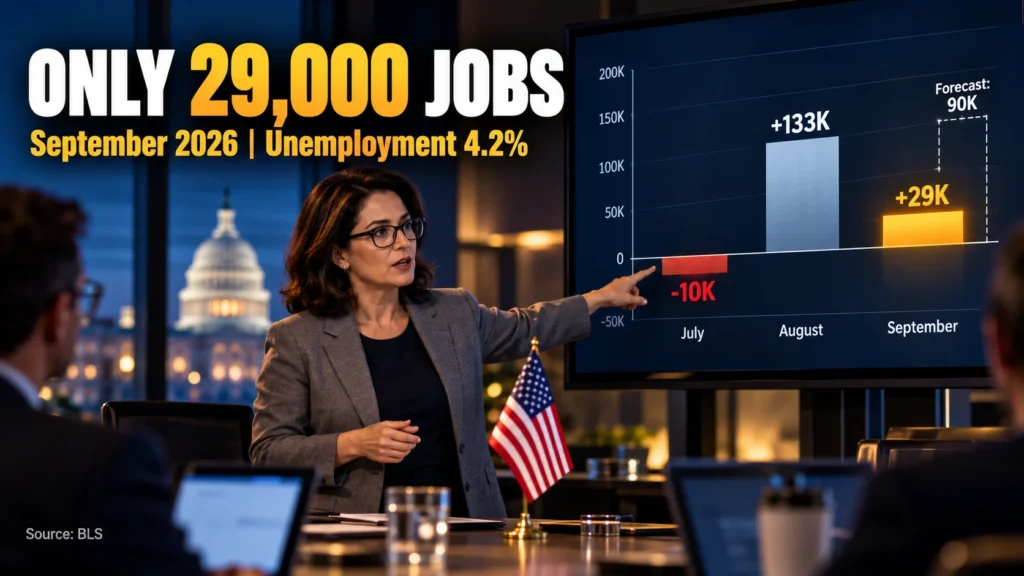
The Bureau of Labor Statistics reported that employers added just 29,000 jobs in September 2026. Economists expected about 90,000. The unemployment rate rose to 4.2% from 4.1%, and revisions erased another 60,000 jobs from July and August. Our breakdown of the September jobs report and why Treasury yields rose covers the market reaction.
Economists call this a low hire, low fire market, and it shapes the whole recession job market ahead. Companies are not slashing payrolls, but they have almost stopped adding people. If you hold a job, you feel safe. If you want one, you feel the freeze.
That gap matters. A job market during recession rarely starts with layoffs. It starts with silence: fewer postings, slower replies, frozen headcount. Layoffs come second, and they arrive when management runs out of patience.
What the WEF Says About the Downturn Risk
The World Economic Forum’s Global Risks Report 2026 surveyed more than 1,300 experts. Economic downturn jumped eight places to #11 in the two-year outlook (p. 9, Fig. 4). Only 5% named it the most likely global crisis of 2026 (p. 8, Fig. 2). Read that correctly: pressure is building, but nobody is calling a collapse.
The IMF projects 3.1% global growth for 2026, below the 3.7% average of 2000–2019 but well above recession territory (p. 40). US forecasts split just as sharply, with Goldman Sachs at 2.5% and RSM at 1.7%, as we compare in our US economy forecast for 2026. That gap is the difference between a soft landing and a stall.
For the bubble risk behind the warning, see our analysis of the global recession 2026 outlook and the AI bubble.
Who Gets Laid Off First in a Recession? The Real Pattern
Who gets laid off first in a recession? Workers in cyclical industries such as construction and manufacturing take the first and heaviest losses. Young workers and workers without a college degree carry a bigger share of the damage than everyone else. Industry and entry point decide your fate more than your performance review does.
Cyclical Industries Go First
In the first half of the 2007–09 recession, a little more than half of all job losses came from manufacturing and construction, according to a BLS analysis of employment in the 2007–09 recession. The 2007–09 downturn shows how a job market during recession sorts workers. Then the damage spread beyond those two sectors. Job losses averaged 712,000 a month from October 2008 through March 2009, the worst six-month stretch since 1945.
The logic is simple. Nobody buys a new house, a new truck or a new machine when the economy turns, so the people who build them go first.
Picture two equally strong coordinators in 2008, one at a homebuilder and one at a hospital system. Same skills, same reviews. One kept a paycheck. The other started job hunting. Performance did not make the difference. The industry did.
Young Workers Carry the Heaviest Load
San Francisco Fed research shows unemployment rates for young workers typically run two to three times those of older workers, and they rise more sharply in downturns. The pattern repeated across past recessions, according to San Francisco Fed research on unemployment by age and race.
The reason starts with hiring. Companies freeze openings before they fire anyone. The 22-year-old who never got the offer feels the recession months before the 45-year-old gets a layoff notice.
Cost plays a role too. As one economist quoted by NPR points out, hiring an entry-level worker takes real time and money to train. When cash gets tight, that investment is the first one a manager cancels.
Less-Skilled and Minority Workers Take Bigger Hits
The same research finds that demand drops hit less-skilled workers harder. It also shows that unemployment rates for Black and Hispanic workers rose more than those for white workers in every recession it reviewed.
That pattern is visible today. The BLS reported Black unemployment at 7.0% in September 2026, the sharpest move among major worker groups that month.
| Group | Why exposed | What the data shows |
|---|---|---|
| Construction and manufacturing workers | Demand for big purchases drops first | About half of early job losses in 2007–09 (BLS) |
| Young workers | Hiring freezes block entry | Unemployment typically 2–3× older workers (SF Fed) |
| Black and Hispanic workers | Larger swings in every recession reviewed | Black unemployment at 7.0% in September 2026 (BLS) |
| Workers without a degree | Less-skilled demand falls hardest | Heavier share of unemployment increases (SF Fed) |
| Recent college graduates | Entry-level and remote-capable roles are cut back | 5.7% unemployment vs 4.1% for all workers in June 2026 (NY Fed) |
Read the table once and the pattern is clear: in any job market during recession, risk follows your industry, your experience level and your entry point, not how hard you work.
It’s Not Who You Think: The 2026 Twist
Past downturns hit cyclical jobs first. This cycle adds a new target: the desk job on the bottom rung. That is what makes the 2026 job market during recession different from 2008.
Entry-Level White-Collar Jobs Are in the Crosshairs
The WEF report cites one estimate that AI can eliminate up to 50% of entry-level white-collar jobs in the US within five years and push unemployment to 10–20% (p. 62). That is the report’s negative scenario, not its base case. It sits next to a rosier one: WEF research cited in the report expects 170 million new roles and 92 million displaced by 2030, a net gain of 78 million worldwide.
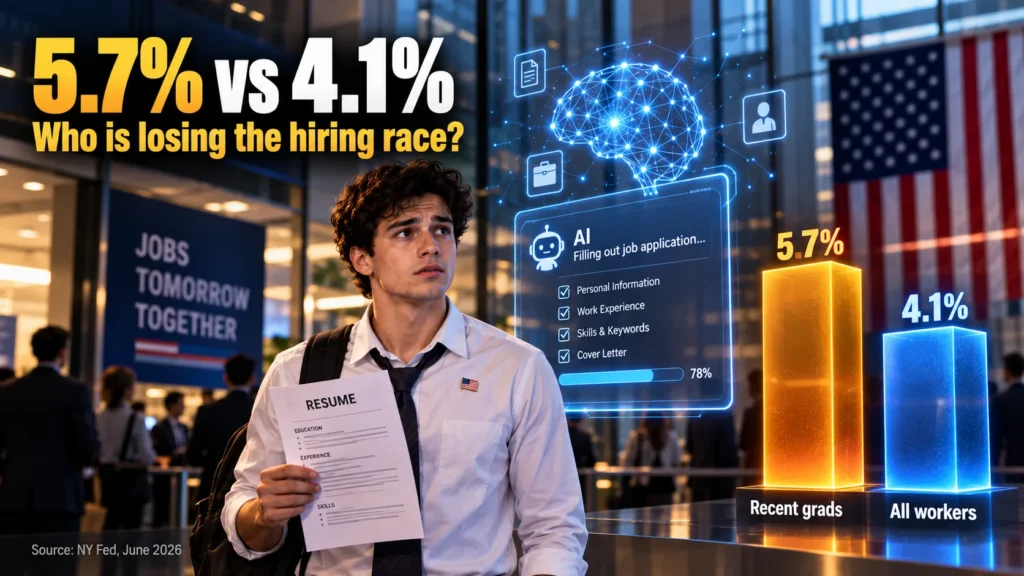
The two views collide, and honest analysis starts there. What no one disputes is the current damage. New York Fed data reported by NPR shows recent graduates at 5.7% unemployment in June, well above the 4.1% rate for all workers.
Why Economists Push Back on the AI Blame
Many recent graduates blame AI. Economists are less sure. The same NPR report notes that the New York Fed found companies are less willing to hire new graduates into roles that can be done remotely, and unemployment among young graduates rose as remote work spread.
One graduate in the NPR report has applied to more than 500 entry-level jobs since last December. So the damage is real and the cause is contested. For you, the cause matters less than the target. If your job consists of routine tasks that a junior hire used to learn on, you sit in the zone of exposure.
Economists describe the current US pattern as a hiring recession: growth continues, but job creation stays weak.
Finance and Government Cut While Health Care Hires
September’s report shows the split in real time. Health care added 17,000 jobs. Government payrolls shrank by 17,000. Financial activities lost 7,000 jobs and sit about 129,000 below a May 2025 peak.
The 2007–09 data tells the same story. While construction and manufacturing collapsed, health care and education kept adding jobs. The best recession-proof jobs share one trait: people cannot postpone the need. No job is untouchable, but some are far harder to cut than others.
One more detail deserves your attention. Construction (+11,000) and manufacturing (+9,000) still added jobs in September. The classic early-warning sectors have not cracked yet. Watch them. When they turn negative, the 2007–09 pattern is back.
The K-Shaped Job Market: Same Recession, Different Outcomes
The WEF describes growth that is “K-shaped,” where some parts of the economy thrive while others struggle (pp. 37, 60, 63). Your recession experience depends on which leg you stand on.
Asset Owners Rise While Wage Earners Slip
Property owners and investors saw their wealth climb. Wage earners without assets fell behind rising living costs (p. 37). In 18 of 37 OECD countries, real wages still sit below their Q1 2021 level. Business leaders feel it: lack of economic opportunity or unemployment ranks as the top national risk in 27 countries and lands in the top five in 72 (p. 37, Fig. 35).
The US shows the same squeeze. Wage growth slowed to 3% in September, the slowest annual pace since 2021, and has trailed inflation for six straight months. This is the engine behind inequality and social polarization as a global risk: a downturn lands hardest on people who live on paychecks alone.
The “White-Collar Rust Belt” Warning
The WEF warns of a “white-collar rust belt” forming in cities that built their economies on knowledge and services (p. 63). It also describes a generation of university graduates pushed into gig work as AI improves.
Unemployment also carries a health cost. Research cited in the report links job loss to higher risks of depression and anxiety, and finding work again reduces that risk (p. 63). The warning carries a political edge too. Middle-class unemployment erodes the tax base and the housing market at the same moment, and that leaves governments with fewer tools to respond.
How to Protect Your Job Before the Cuts Start
You cannot control the job market during recession. You control how exposed you are when it turns. Here is how to prepare for layoffs while you still have a paycheck.

Make Your Role Hard to Cut
Find out which budget line pays your salary: revenue, cost or “nice to have.” Roles tied to revenue or compliance are harder to cut. Roles tied to experiments are not.
Then build proof. Keep a running record of results with numbers: money saved, deals closed, hours cut. When managers draw up a cut list, they weigh evidence, not effort. Build relationships outside your team too. People who know your work defend it. Ask your manager one direct question: “If budgets dropped 10%, what would you protect first?” The answer shows exactly where you stand.
Build Your Runway Now
Payrolls grew by only 29,000 jobs in September, and 7.1 million Americans were unemployed. Every opening draws a crowd, so a job search takes longer. Plan for that. The standard rule of thumb for an emergency fund is three to six months of expenses. Start with one month and build from there.
Cut one recurring cost this week. Pause new debt. Cash buys you the one thing a recession takes away: time to choose.
Learn the Tools Your Role Is Rebuilt Around
The WEF urges employers and governments to treat reskilling as a core part of AI rollout and to target support at youth, routine service and administration roles, and older workers (p. 66). Do not wait for your employer to act on that advice.
If AI now handles your routine tasks, become the person who supervises it, checks it and fixes it. That role is harder to cut.
| Your situation | Risk level (our read) | Your move this month |
|---|---|---|
| Construction, manufacturing, housing-linked jobs | High | Cross-train toward maintenance, compliance or supervision |
| Finance and back-office roles | Elevated | Document revenue or cost impact; learn the automation tools |
| Entry-level white-collar roles | Elevated | Build a portfolio of real results; apply beyond remote-only openings |
| Government roles | Elevated | Update your resume now; map private-sector equivalents |
| Health care and care support | Lower | Add a credential that moves you up the ladder |
Pick the row that matches you, then do the move before the end of the month. Waiting is the only losing strategy.
Job Search During Recession: What to Do If the Layoff Already Happened
A layoff is a business decision, not a verdict on you. Treat the first 72 hours as logistics: severance terms, benefits and cash flow. Then move.
Go Where the Hiring Is
Aim at sectors still adding jobs, health care first. Layoffs during recession pile thousands of candidates into the same shrinking pool, so speed matters. Even inside health care the split is sharp: ambulatory care and hospitals added jobs in September while nursing and residential facilities lost 9,000. Use your network before job boards. Referrals bypass the crowd that every public opening attracts. Take contract or bridge work while you search. A paycheck extends your runway and keeps your resume current.
Rewrite Your Resume With Proof
Recession resume tips come down to one rule: lead with measurable results. Swap “responsible for” with numbers that show impact. Compare “Managed vendor contracts” with “Cut vendor costs 14% across 22 contracts.” The second line gets the interview. That example is illustrative, so use your own real numbers. With openings scarce, each one draws a crowd, so a resume without proof gets skipped.
FAQ
Who gets laid off first in a recession?
Workers in cyclical industries such as construction and manufacturing, followed closely by young workers and those without a college degree. In 2007–09, manufacturing and construction supplied a little more than half of early job losses.
Are jobs available during a recession?
Yes, but they concentrate in specific sectors. Health care added 17,000 jobs in September 2026 even in a weak report, and it kept growing through the 2007–09 downturn.
Do salaries drop during a recession?
Raises stall before pay falls. US wage growth hit 3% in September, the slowest annual pace since 2021, and trailed inflation for six straight months.
Should I quit my job during a recession?
Not without a signed offer. With payrolls up only 29,000 in September, a gap between jobs costs more than it did in a hot market. Move only when the next role is secure.
What is a hiring recession?
It is a stretch where the economy keeps growing but companies hire very little. Layoffs stay low, yet job seekers and new graduates struggle to land roles.
Conclusion
Here is the whole story in four lines. In any job market during recession, industry decides who goes first. Young and entry-level workers carry the heaviest load. The 2026 twist adds white-collar entry roles to the danger zone. And the K-shaped economy rewards people who own assets and own skills.
You cannot stop a downturn, but you can choose your position before it hits. Build proof, build cash, build skills.
The next downturn will sort workers into two groups: those who saw it coming and those who got a calendar invite. Pick your group today.
Disclaimer: This article is for informational purposes only and is not financial, investment, legal or career advice. Economic data and forecasts change, so verify current figures with official sources before you make decisions.
About the Author – Abhishek Chouhan
Abhishek Chouhan is a Global Finance Analyst and Market Researcher with over 15 years of experience studying stock markets, investor behavior, and long-term wealth cycles across the US, Europe, and Asia. He is the founder of MoneyUncut.com, a global financial intelligence platform focused on decoding market psychology, economic trends, and how human behavior shapes financial outcomes.