
Your savings, your mortgage and your job all sit downstream of one risk most people have never heard of. The World Economic Forum ranked it the number one global risk for the next two years, ahead of war and extreme weather, and it is not the AI bubble everyone is panicking about. Here is what Global Recession 2026 really looks like, where the AI bubble truly fits, and which signals matter before the next crash headline lands.
Every week brings a fresh scare: a stock market crash call on Monday, a tariff shock on Wednesday, an oil spike on Friday. Most of it is noise. So we went to the source, the World Economic Forum’s Global Risks Report 2026, a 102-page assessment built on the views of more than 1,300 leaders and experts, and we set its hard numbers against the IMF’s fresh October forecasts. The picture is sharper, and less comfortable, than the headlines suggest.
Global Recession 2026: Where the World Economy Stands Today
What the IMF Says Right Now
The IMF’s October 2026 World Economic Outlook puts world growth at 3.1% this year and 3.4% in 2027. That is a small lift from July’s 3.0% and a clear step down from 3.5% in 2025.
(Source: IMF World Economic Outlook, October 2026)
Read that as a slowdown, not a collapse. But the fine print matters. Only 32 economies now produce 95% of global growth, down from 54 in April. Global inflation is forecast at 4.7%. And the forecast leans on two assumptions: the AI investment boom holds, and Strait of Hormuz shipments resume by March 2027. Pull either support away and the IMF global growth forecast changes fast.
What Actually Counts as a Global Recession
One bad quarter in one country is not a global recession. The world economy has to slow to roughly 2% growth or below, or contract outright. The WEF uses a similar yardstick: its survey defines an economic downturn as near-zero or slow global growth lasting several years, or a full contraction.
(Source: WEF Global Risks Report 2026, Figure 37, p. 40)
At 3.1%, the world sits well above that line today. So the honest answer on Global Recession 2026 is not yet, and not by default. The real question is what can push growth down, and that is where the WEF report earns its place.
What the WEF Global Risks Report 2026 Actually Measures
Who Answered the Survey
The report rests on the Global Risks Perception Survey: more than 1,300 experts from academia, business, government, international organisations and civil society, polled between 12 August and 22 September 2025. A second survey adds the views of over 11,000 business leaders across 116 economies.
(Source: WEF Global Risks Report 2026, Overview of methodology, p. 6)
What It Is Not
It is not a forecast. The Forum says so itself: the report offers no predictions and does not treat the future as fixed.
(Source: WEF Global Risks Report 2026, Preface, p. 4)
It maps what experts fear, how severely they rate it, and how one risk feeds another. Think of it as a radar, not a crystal ball. One timing note: the survey closed in September 2025. Since then the world has added a regional war and an energy shock, which is why this article pairs the WEF’s risk map with the IMF’s October 2026 numbers.
The Mood of the Experts: Brace for Turbulence
Half of the experts surveyed expect a turbulent or stormy world over the next two years. That share jumped 14 percentage points in a year. Over ten years it reaches 57%. Only 1% expect calm.
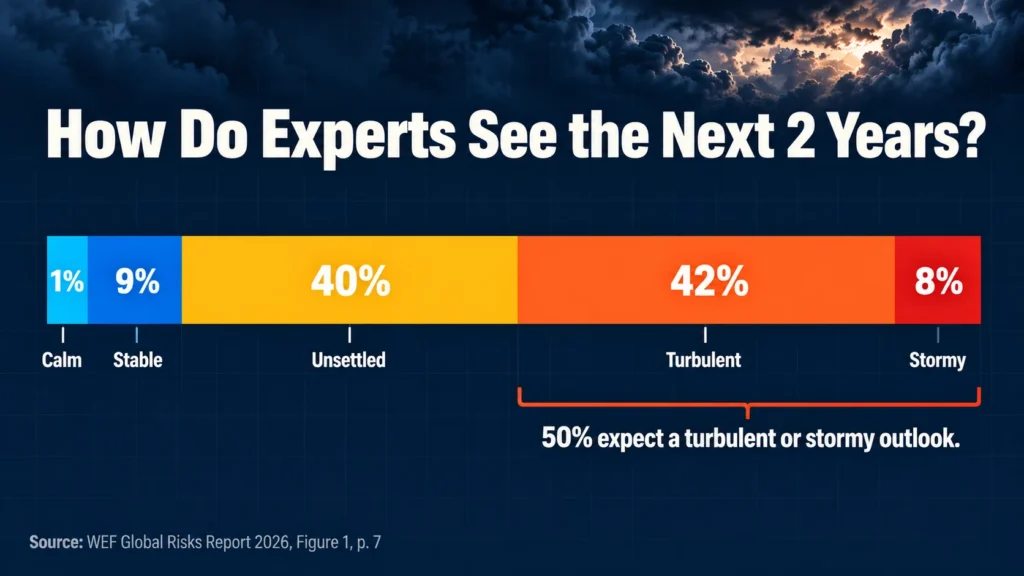
(Source: WEF Global Risks Report 2026, Figure 1, p. 7)
Look at the split before you panic. For the two-year view, 42% say turbulent and 8% say stormy, the label reserved for looming global catastrophes. Another 40% say unsettled. Experts see trouble, and most do not see disaster. That gap between trouble and disaster is the space where Global Recession 2026 gets decided.
The Number One Threat Is Not the AI Bubble
Geoeconomic Confrontation, Explained
Geoeconomic confrontation sounds like jargon. It is simple. Countries are using trade, money and technology as weapons: tariffs, sanctions, capital restrictions, weaponised supply chains. The WEF ranks it the most severe risk for the next two years, up eight places from last year.
(Source: WEF Global Risks Report 2026, Section 1.2, p. 16)
How Strong Is the Vote?
Asked which risk is most likely to trigger a material global crisis in 2026, 18% of respondents picked geoeconomic confrontation. State-based armed conflict took 14% and extreme weather 8%. Economic downturn got 5%, adverse outcomes of AI 4%, and asset bubble burst just 2%.
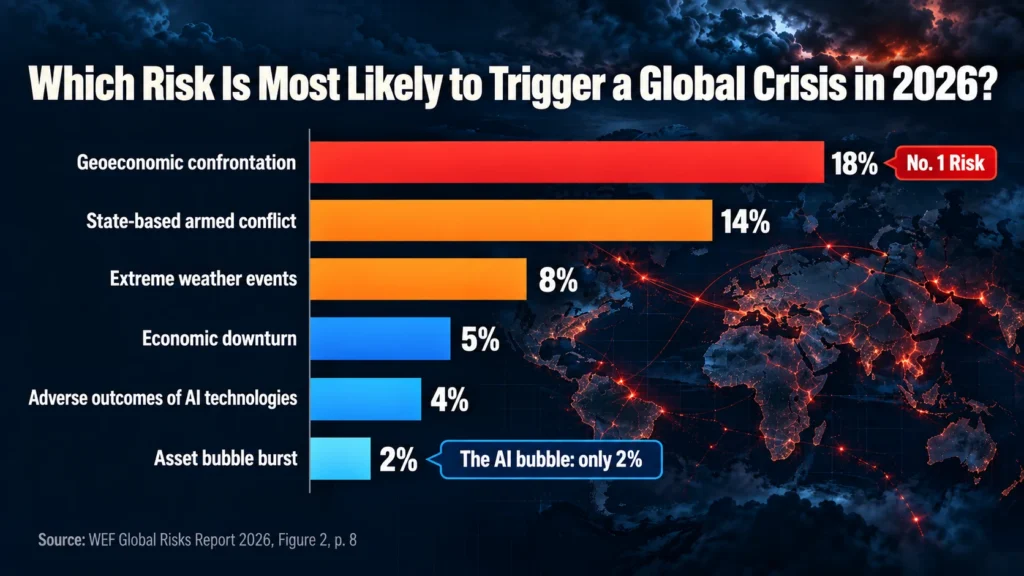
(Source: WEF Global Risks Report 2026, Figure 2, p. 8)
Why a Trade War Turns Into a Recession
The chain is short. Tariffs raise costs. Supply chains reroute. Companies freeze hiring and investment. Central banks cannot cut rates freely because prices are rising. Growth slows while inflation stays hot. No bubble needs to burst for that sequence to hurt, and that is exactly why the WEF puts it first.
Economic Downturn: The Fastest Climber on the List
Economic risks posted the sharpest rise of any category in the WEF’s two-year ranking. Economic downturn climbed eight places to #11. Inflation also rose eight, to #21. Asset bubble burst rose seven, to #18. Among all 33 risks, only these three and geoeconomic confrontation moved up by more than four places.
(Source: WEF Global Risks Report 2026, Section 2.4, p. 40)
The severity score for economic downturn rose by more than any risk except geoeconomic confrontation. It now sits at 4.09 on a 1-to-7 scale. The table below puts the full picture in one place.
(Source: WEF Global Risks Report 2026, Key findings, p. 8; Figure 37, p. 40)
Table 1: Economic and Technology Risks in the WEF Global Risks Report 2026
| Risk | 2-Year Rank (to 2028) | Change vs Last Year | 10-Year Rank |
|---|---|---|---|
| Geoeconomic confrontation | #1 | +8 | #19 |
| Economic downturn | #11 | +8 | #24 |
| Debt | #16 | -1 | #17 |
| Asset bubble burst | #18 | +7 | #27 |
| Inflation | #21 | +8 | #31 |
| Adverse outcomes of AI technologies | #30 | n/a | #5 |
(Source: WEF Global Risks Report 2026, Figure 10, p. 14; Section 2.4, pp. 40-41)
The pattern is hard to miss. Economic risks are climbing fast in the short term and sit far down the ten-year list. Recession fear is a two-year story. AI is the mirror image: near the bottom now, fifth in a decade.
The AI Bubble: How Real Is the Threat?
The Money on the Table
Global AI spending is estimated at $1.5 trillion in 2025 and $2 trillion in 2026. The top eight US hyperscalers alone spent $258 billion on data centres in 2024.
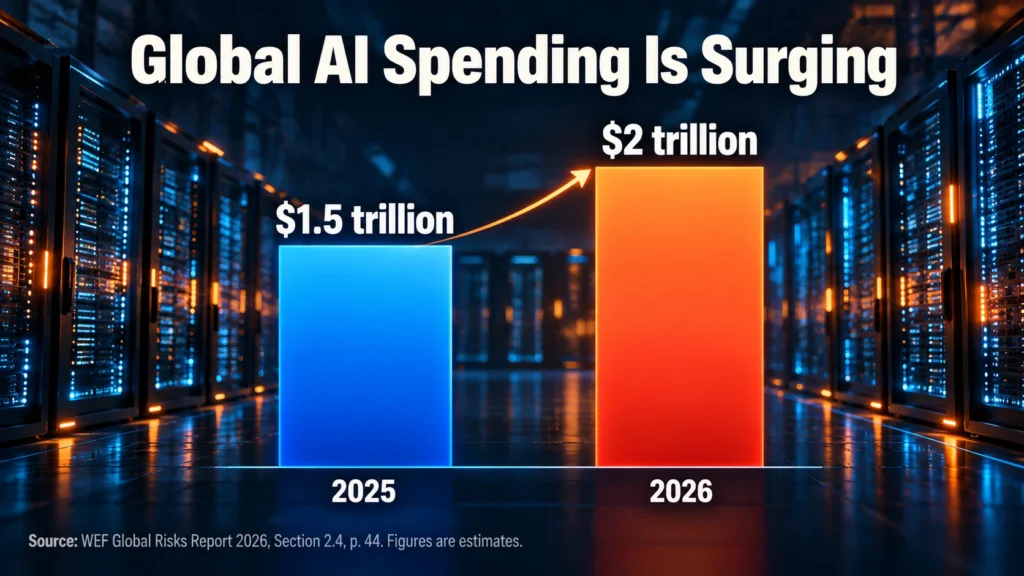
(Source: WEF Global Risks Report 2026, Section 2.4, p. 44)
The IMF credits the AI investment boom for holding growth up this year. So the AI bubble question cuts both ways. AI is the life support of the current expansion and its biggest single liability.
Where the Bubble Case Breaks Through
The WEF flags four weak points. Revenues from AI spending are hard to estimate. Many companies will lose while a few win. Cheaper rivals will undercut prices, and GPUs go obsolete quickly. And the build-out is shifting from company cash to debt and opaque special-purpose vehicles, with up to $1.5 trillion of investment-grade bonds expected from AI builders over five years.
(Source: WEF Global Risks Report 2026, Section 2.4, pp. 42, 44)
What Would Pop It
The Forum names the trigger: investor worry about funding and debt outweighing excitement about future revenue. A second trigger is public backlash over data-centre water use, job losses or inequality. For the valuation metrics behind this fear, our breakdown of the global stock market bubble shows how stretched prices already are.
Why the Damage Spreads Worldwide
Global investors hold heavy exposure to US stocks by historical standards. A fall on the scale of the 2000 dotcom bust would destroy far more wealth today, and the hit to consumer demand would be severe. In September 2025, 85% of global chief economists said a financial shock would have wide systemic effects. Passive fund flows add a loop: the biggest stocks attract the most money, and if flows reverse, the selling feeds itself.
(Source: WEF Global Risks Report 2026, Section 2.4, p. 43)
The IMF’s Stress Test
In its October 2026 downside scenario, the IMF models a 20% equity fall that leaves world growth 1.1% below baseline by 2028.
(Source: IMF World Economic Outlook, October 2026, as reported at the Annual Meetings)
The Verdict on the AI Bubble
The AI bubble is a real risk and a powerful amplifier. It is not the leading threat. The WEF ranks asset bubble burst #18 for the next two years, and only 2% of respondents see it as the top trigger of a crisis in 2026. A bubble needs a match. Trade wars, debt stress and energy shocks supply the matches.
Debt: The Slow Fuse Under Everything
The Size of the Problem
Global debt, public and private combined, stood at $251 trillion in 2024, which is 235% of world GDP. The United States is running a deficit of 5.6% of GDP in 2025, rising to 5.9% in 2026 and 6.0% in 2027. Federal debt held by the public climbs from 100% of GDP today to 120% by 2035, above the 106% record set in 1946.
(Source: WEF Global Risks Report 2026, Section 2.4, p. 41)
The Refinancing Wall
Nearly 45% of OECD sovereign debt matures between 2025 and 2027. About a third of global corporate debt needs refinancing in the same window. Interest rates are far above their pre-2022 lows, so every rollover costs more.
(Source: WEF Global Risks Report 2026, Section 2.4, pp. 41-42)
The UK Warning Shot
The WEF points to the 2022 UK gilt sell-off as the template for bond market stress. British households felt it directly through mortgage rates. Private credit is the newer worry: bankruptcies in the second half of 2025 pushed the Financial Stability Board to call for close monitoring, even as retail investors pile in.
(Source: WEF Global Risks Report 2026, Section 2.4, p. 42)
Interest Rates and Liquidity: The Pressure Gauge
Rates set the price of everything. When borrowing costs stay high, valuations compress, refinancing hurts and weaker companies fail first. To see how central bank decisions travel through every asset class, read how interest rates control global markets.
Liquidity is the second gauge. When easy money thins out, even strong balance sheets get squeezed, and that is why analysts treat global liquidity drying up as an early crash warning. Debt, rates and liquidity form one pressure system. A shock in any one of them reaches the other two within weeks.
Stagflation Risk: The Boomerang Inflation Problem
The WEF cited an IMF projection of 3.7% global inflation for 2026. The IMF’s October outlook now forecasts 4.7%, a full percentage point higher, as war-driven energy costs bite.
(Source: WEF Global Risks Report 2026, Section 2.4, p. 44; IMF World Economic Outlook, October 2026)
That is the raw material of stagflation: slowing growth with rising prices. It traps central banks. Cut rates to rescue growth and inflation runs hotter. Hold rates to fight inflation and the slowdown deepens. The WEF adds a deeper fear: governments under debt pressure leaning on central banks to finance spending, which would keep inflation elevated for years.
(Source: WEF Global Risks Report 2026, Section 2.4, pp. 44-45)
Recession Indicators: What to Watch Next
You do not need a Bloomberg terminal. You need seven signals, checked monthly.
Table 2: Global Recession 2026 Warning Signals
| Signal | What It Tells You | Where to Track It |
|---|---|---|
| World growth near 2% | Global recession territory | IMF World Economic Outlook updates |
| Sharp fall in AI and mega-cap stocks | Bubble deflating, wealth effect hits spending | Major index levels, earnings reports |
| Government bond yield spikes | Debt refinancing under strain | UK gilts, US Treasuries |
| Credit and private credit stress | Lenders pulling back | Central bank stability reports |
| Inflation re-accelerating | Stagflation pressure building | Monthly CPI releases |
| Rising unemployment | Consumer demand weakening | National jobs reports |
| Energy price spikes | Supply shock feeding costs | Oil and gas benchmarks |
One red flag is noise. Three together are a pattern. For policy direction, follow the Bank of England’s monetary policy decisions and the Federal Reserve’s policy statements, because rate moves turn most of these signals up or down.
Gold and Safe Havens: Do They Still Protect You?
Gold usually draws money when markets shake, and our guide to gold during a market crash covers that pattern in depth. But price matters. The WEF notes that a sharp run-up in precious metals has already raised bubble concerns, and some of those prices have since stabilised or corrected.
(Source: WEF Global Risks Report 2026, Section 2.4, p. 43)
A safe haven bought at a euphoric price is not safe. Treat gold as insurance in a portfolio, not as a guaranteed shelter.
How to Prepare for a Recession in 2026
Build the Buffer First
Keep three to six months of essential expenses in cash. Everything else on this list depends on it. A buffer turns a job scare into an inconvenience.
Cut Fragile Debt
List every variable-rate loan and every fixed deal that expires in the next 24 months. UK mortgage holders and US adjustable-rate borrowers carry the most refinancing exposure. Move first, before rates and lenders decide for you.
Diversify Beyond the AI Trade
Most index funds are now heavily weighted toward a handful of mega-cap tech names, a concentration the WEF links directly to passive flows. Check what you actually own. Spread exposure across regions, sectors and asset types.
Keep Your Skills Current
The WEF lists job displacement from technology among the triggers of public backlash against AI. Your best hedge is skills that employers still pay for when budgets tighten.
This is general information, not personal financial advice.
The 10-Year View: Today’s Storm Is Not Tomorrow’s
In the ten-year outlook, geoeconomic confrontation falls from #1 to #19, economic downturn sits at #24 and asset bubble burst at #27. Environmental risks lead the long-term list, with extreme weather at #1 and biodiversity loss at #2. AI outcomes rise to #5, the sharpest short-to-long climb among all 33 risks.
(Source: WEF Global Risks Report 2026, Section 1.3, p. 19; Preface, p. 4)
The lesson is clear. Economic panics pass. Structural risks stay. Plan your next two years for volatility and your next ten for resilience.
So, Are We Headed for a Crash?
Global Recession 2026 is not the base case. The IMF projects 3.1% growth, and the WEF ranks economic downturn #11, not first. But the setup is fragile. Growth is concentrated in 32 economies. Debt is at record levels and needs refinancing. An energy shock is feeding inflation. And AI valuations carry the weight of the whole expansion.
The verdict: a slowdown with a loaded trigger. A crash needs a spark, and the WEF and IMF point to three. A funding crack in the AI build-out. A bond market break. An escalation of economic warfare. Watch those, ignore the daily noise, and you will see it coming before the headlines do.
FAQ: Global Recession 2026
Is the world in a global recession right now?
No. The IMF’s October 2026 outlook puts world growth at 3.1%, far above the roughly 2% line that marks global recession territory. The danger sits in the setup: concentrated growth, heavy debt and an energy shock. Global Recession 2026 is a risk to manage, not a verdict already delivered.
Will the AI bubble burst in 2026?
Nobody can date it, and anyone who does is guessing. The data shows the WEF ranks asset bubble burst #18 for the next two years, while the IMF models a 20% equity fall costing 1.1% of global growth by 2028. The trigger to watch is funding stress, not enthusiasm.
What is geoeconomic confrontation?
It is the use of tariffs, sanctions, capital controls and supply chain pressure as tools of national strategy. The WEF Global Risks Report 2026 ranks it the top risk for the next two years.
Will the stock market crash in 2026?
Markets move on triggers, not calendars. The WEF warns that a US downturn on the scale of the 2000 dotcom bust would destroy far more wealth today, because investor exposure is higher. The IMF baseline shows no crash. Plan for volatility, not for a date.
How do I prepare for a recession in 2026?
Five moves: hold three to six months of expenses in cash, cut variable-rate and refinancing-sensitive debt, diversify beyond mega-cap tech, keep your skills current, and track the recession indicators in Table 2 every month. Buffer first.
What is the difference between a recession and stagflation?
A recession is a sustained fall in economic activity. Stagflation pairs weak growth with high inflation, which traps central banks: cutting rates feeds prices and raising them deepens the slowdown. With the IMF forecasting 4.7% inflation for 2026, this is the path to watch.
Conclusion
Here is the whole story in five lines. The WEF ranks geoeconomic confrontation, not the AI bubble, as the top risk. Economic downturn is the fastest climber on the list. Debt, rates and inflation form the pressure system underneath. The AI bubble is the amplifier that can turn a slowdown into a crash. And the IMF’s 3.1% growth says the world is bending, not breaking.
That is not a reason to freeze. It is a reason to move. The people who get hurt in a downturn are rarely the ones who saw the risk coming. They are the ones who saw it and waited. Build your buffer, trim your fragile debt, spread your exposure and watch your signals.
You cannot schedule the next shock. You can schedule your preparation, and that decision starts today.
Disclaimer: This article is for informational purposes only and does not constitute financial, investment or legal advice. Figures are drawn from the World Economic Forum Global Risks Report 2026 and the IMF World Economic Outlook, October 2026, and reflect data available on 15 October 2026. Markets are unpredictable and past performance does not guarantee future results. Consult a qualified financial adviser before making investment decisions.
About the Author – Abhishek Chouhan
Abhishek Chouhan is a Global Finance Analyst and Market Researcher with over 15 years of experience studying stock markets, investor behavior, and long-term wealth cycles across the US, Europe, and Asia. He is the founder of MoneyUncut.com, a global financial intelligence platform focused on decoding market psychology, economic trends, and how human behavior shapes financial outcomes.