

You have $100, a phone, and a knot in your stomach. Every app promises easy money, and every story about a frozen account or a market drop makes you wonder if you are about to make a mistake you cannot undo. That fear is healthy, and it is exactly why choosing among the best trading platforms for beginners matters more than choosing your first stock.
Here is what most guides skip: “safe” means two different things. One is whether the platform can lose your money. The other is whether the market can. You control the first. You never control the second.
By the end of this guide, you will know which platforms pass the safety test, what they really cost, and how to place your first $100 without regret.
What “Safe” Actually Means When You Start With $100

Design is not safety. A clean app tells you nothing about whether your money is protected. Real safety has two layers, and you need both.
Layer One: Can the Platform Lose Your Money?
A legitimate U.S. broker is registered with the SEC, is a FINRA member, and belongs to SIPC. SIPC protection covers up to $500,000 per customer, including $250,000 in cash, if a member firm fails and your assets go missing. Before you deposit a dollar, look up the firm on FINRA BrokerCheck and confirm SIPC membership on sipc.org. Those two minutes filter out most of the danger.
Layer Two: Can the Market Lose Your Money?
Yes, and no platform stops it. SIPC does not cover market losses. If a stock drops 20%, that loss is yours on Fidelity or on any other app. The market has humbled far bigger portfolios than yours, and the history of major stock market crashes shows the pattern repeating.
So the honest definition is simple: a SIPC protected brokerage plus a plan sized so that a bad month does not hurt your life. That is what “safe” means for the best trading platforms for beginners.
Can You Really Start Trading With $100? Yes
A few years ago, one share of a big company could cost more than your entire budget. Fractional shares ended that problem. You buy a slice of a stock or ETF by dollar amount instead of buying a whole share.
Fractional Shares: Where the $1 Start Comes From
Fidelity and Robinhood let you start from $1. Schwab and Webull start at $5. E*TRADE does not offer fractional trading, according to Fidelity’s own broker comparison, which makes it a weak fit for a $100 start.
Account Minimums Are Mostly Gone
Fidelity, Schwab, and Robinhood all offer a brokerage account with no minimum. The one exception is margin: FINRA rules require $2,000 in equity to hold a margin account. As a beginner, skip margin entirely.
Commission-free trading on U.S. stocks and ETFs is now standard across every major broker. That means commissions are no longer the way to pick a winner. The differences sit in safety, tools, and the costs you do not see on the homepage.
The Best Trading Platforms for Beginners at a Glance
Here is how the four most recommended platforms compare on the numbers that matter for a $100 start. Data reflects September 2026, so confirm each fee page before you deposit.
| Platform | Best For | Account Minimum | Fractional Shares From | Stock/ETF Commissions | Watch Out For |
|---|---|---|---|---|---|
| Fidelity | Best overall | $0 | $1 | $0 | More menus than a beginner needs |
| Charles Schwab | Support and education | $0 | $5 | $0 | Higher fractional minimum than Fidelity |
| Robinhood | Mobile simplicity | $0 | $1 | $0 | $100 outgoing transfer fee, narrower selection |
| Webull | Practice and charting | $0 | $5 | $0 | Earns payment for order flow |
All four are SIPC members. The table shows one thing clearly: the price of entry is the same everywhere, so the decision comes down to how each platform treats you after the first deposit.
Fidelity vs Schwab vs Robinhood for Beginners: The Breakdown
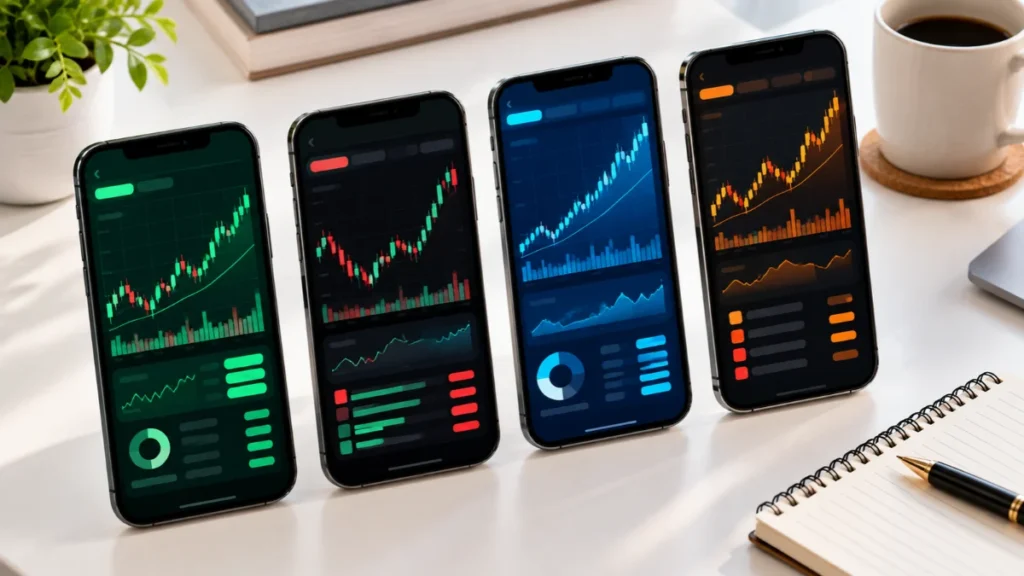
Fidelity: The Best All-Around Pick
Fidelity has a $0 account minimum, $0 commissions, and fractional investing from $1. It also offers zero-expense-ratio index funds, which is rare and valuable for a small account. Fidelity is listed among the brokers that do not accept payment for order flow. The drawback is real: the platform has more menus and tools than a first-timer needs. Learn the five screens you use and ignore the rest. For most beginners, this is the default choice.
Charles Schwab: Best for Support and Learning
Schwab charges no minimum, no standard maintenance fee, and $0 commissions on online stock and ETF trades. It pairs strong education with paper trading and a large branch network, so you can talk to a human when something feels wrong. Its Stock Slices program starts at $5. Choose Schwab if you value support over speed.
Robinhood: Best for Mobile Simplicity
Robinhood builds the cleanest app of the group. Fractional shares start at $1, recurring investments run by dollar amount, and support runs 24 hours. The tradeoffs: no traditional mutual funds, a heavy push toward crypto and active trading, and a $100 fee if you ever transfer out. Its optional Gold tier costs $5 a month. Use Robinhood if simplicity keeps you investing.
Webull: Best for Practice and Charts
Webull gives you a free app, fractional shares from $5, and a paper trading account so you can rehearse trades with fake money. It earns revenue from payment for order flow, so read the next section before you commit. Choose Webull if you want to learn charts before you risk cash.
The Hidden Costs of “Free” Trading
Zero commission does not mean zero cost. Brokers earn money somewhere, and you deserve to know where.
Payment for Order Flow, Explained
Some brokers route your order to a market maker who pays them for the business. Robinhood, Webull, and Schwab accept this. The result can be a slightly worse fill price on your trade. On $100, the difference is tiny. As your balance grows, it matters. Institutions study this fine print for a living, and the gap between smart money and retail investors starts with details like this.
The Costs That Do Not Appear on the Homepage
| Cost | Where It Shows Up | Your Move |
|---|---|---|
| Outgoing transfer fee | Robinhood charges $100 per its fee schedule | Pick a long-term home first |
| Subscription tiers | Robinhood Gold is $5 a month | Skip paid tiers at $100 |
| Mutual fund fees | Fidelity charges $0 on its own funds, up to $49.95 on others | Stick to ETFs or in-house funds |
| Margin interest | Rates vary widely; at $50,000 borrowed, 4.9% vs 10.575% is a $2,838 yearly gap | Do not borrow as a beginner |
Every one of these costs is avoidable if you know it exists. Read the fee page once, and you never pay a surprise.

Your First $100: A Simple Plan
Follow this four-step plan to choose among the best trading platforms for beginners, verify your broker’s safety, and invest your first $100 with confidence.
Step 1: Practice With a Paper Trading Account
Open a paper trading account at Webull or Schwab and place ten practice trades in the size you plan to use for real. If the screen confuses you, fix that before real money is involved.
Step 2: Verify Before You Deposit
Look up the firm on FINRA BrokerCheck and confirm SIPC membership on sipc.org. This two-minute check removes the biggest risk you can control.
Step 3: Buy Broad, Not Exciting
Put your $100 into a diversified index ETF instead of a single hot stock. Then automate a recurring purchase. Fear and greed cause most beginner mistakes, and the psychology behind investing decisions explains why automation beats mood every time.
Step 4: Think About a Roth IRA
A Roth IRA brokerage account at Fidelity, Schwab, or Robinhood lets earnings grow tax-free, and you can withdraw your contributions without penalty. Build a cash emergency fund first, then use the Roth for long-term money.
FAQ
What is the best trading platform for beginners in 2026?
Fidelity is the strongest all-around choice: $0 minimum, $0 commissions, and fractional shares from $1. Robinhood wins on mobile simplicity, and Schwab wins on support.
Is Robinhood good for beginners?
Yes, for simplicity. The app is easy, fractional shares start at $1, and support is available around the clock. Its narrower investment selection and $100 transfer-out fee are the tradeoffs.
Are trading apps safe?
Regulated, SIPC-member brokers are safe from a firm-failure standpoint, with coverage up to $500,000. They are not safe from market losses. No app protects you from a falling stock price.
How much money do I need to start trading stocks?
$1 at Fidelity or Robinhood, and $5 at Schwab or Webull. You do not need a large balance to begin.
Do trading apps charge hidden fees?
Commissions are $0, but costs hide in payment for order flow, transfer-out fees, subscription tiers, and margin interest. Check the fee schedule before you deposit.
Can beginners practice trading without real money?
Yes. Webull and Schwab offer paper trading accounts with virtual cash. Use one for at least two weeks before you fund a real account.
Conclusion
You now know the difference between platform safety and market risk, the four platforms worth your attention, and the fees hiding behind “free.” Pick a SIPC-member broker, verify it, practice first, and buy broad. Fidelity is the default, Robinhood is the simple route, and Schwab is the supported one.
$100 is not too small to start. It is the exact size of a low-risk lesson. Start the account today, because the market rewards the people who begin, not the people who wait for certainty.
Disclaimer: This article is for informational and educational purposes only and is not financial advice. All investing involves risk, including loss of principal. Fees, minimums, and features change, so verify current details on each broker’s official website before you invest. MoneyUncut has no affiliate relationship with, and receives no compensation from, any platform mentioned.
About the Author – Abhishek Chouhan
Abhishek Chouhan is a Global Finance Analyst and Market Researcher with over 15 years of experience studying stock markets, investor behavior, and long-term wealth cycles across the US, Europe, and Asia. He is the founder of MoneyUncut.com, a global financial intelligence platform focused on decoding market psychology, economic trends, and how human behavior shapes financial outcomes.