
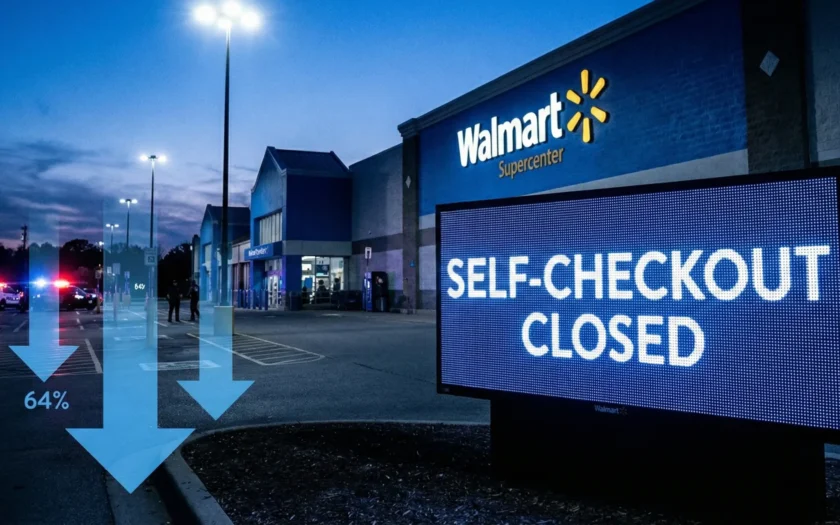
In early 2024, Walmart made a quiet but bold decision inside its Shrewsbury, Missouri, Supercenter: it shut down every self-checkout kiosk and shifted back to traditional cashier lanes. What happened next has now become one of the most talked-about case studies in U.S. retail.
Within just a few months, police calls linked to the store fell by 64%, and arrests declined by 55%. Local officials, police officers, and retail analysts were stunned. A single operational change — removing self-checkout machines — appeared to dramatically reduce crime and restore order in a store that once demanded constant law-enforcement attention.
This unexpected outcome has opened a national conversation: Is automation making theft worse? And could human cashiers be an underrated security asset in modern retail?
Retail Theft: A Growing U.S. Crisis
Retail shrink has become a massive headache for American retailers. Industry estimates suggest that merchants lost more than $45 billion in 2024, a number that continues to rise year after year. Organized retail crime, opportunistic shoplifting, and under-scanning at self-checkout machines all contribute to these losses.
Large chains, including Walmart, had heavily invested in self-checkout technology in the past decade. The promise was simple:
lower labor costs + faster lanes = higher efficiency.
But for many stores, the reality turned out differently. Data from multiple retail studies shows that shrinkage is consistently higher at self-checkout than at staffed registers. Even the best AI surveillance systems have struggled to prevent missed scans, intentional theft, and user-generated errors.
By late 2022, Walmart CEO Doug McMillon publicly acknowledged that shrink was a major issue, hinting that unchecked theft could lead to price increases or even store closures. The warning reflected growing tension within the company — technology improved speed, but it didn’t always improve security.
Why Shrewsbury Saw a 64% Drop in Crime
Before April 2024, Walmart accounted for nearly a quarter of all police calls in Shrewsbury, a small city southwest of St. Louis. Officers were frequently pulled from other community needs to respond to shoplifting, altercations, and disputes happening at Walmart’s self-checkout area.
After the self-checkout removal, crime fell dramatically.
The local police chief called the change “huge,” praising Walmart for easing the burden on the department.
Several factors likely contributed:
1. Reduced Theft Opportunities
Self-checkout creates small windows that make under-scanning or intentional theft easier. Human cashiers close that gap.
2. Increased Social Accountability
People behave differently when interacting with a real cashier. Human presence discourages impulsive theft in ways machines cannot.
3. Fewer Accidental Errors
Some arrests stemmed not from intentional theft but from misunderstandings or scanning mistakes. Cashiers eliminated many such incidents.
4. Better Store Oversight
Associates monitoring lanes directly are more effective than relying fully on cameras and software.
The overall result: fewer crimes, fewer arrests, fewer police calls, and smoother store operations.
A National Ripple Effect: More Stores Rethinking Automation
Shrewsbury wasn’t an isolated incident. Walmart has quietly removed self-checkouts from other high-theft stores in:
- New Mexico
- Cleveland
- Los Angeles
Other national retailers are also adjusting. Dollar General removed self-checkout machines from thousands of stores after reporting rising theft losses — and saw improvement similarly.
Still, the move remains selective rather than widespread. Walmart has not announced a nationwide rollback. The company continues to expand advanced self-checkout systems in other markets and promote mobile-based “Scan & Go” features at its Sam’s Club stores.
This reflects Walmart’s evolving two-tiered strategy:
• Remove self-checkouts in high-risk areas
where theft outweighs efficiency benefits.
• Upgrade technology and security in stable locations
using AI, RFID, and more associates to monitor lanes.
Security Measures Walmart Is Adding
Even where kiosks remain, Walmart is investing heavily in:
- AI-powered missed scan detection
- More staff stationed near self-checkout
- RFID-enabled tracking systems
- Off-duty police officers in high-loss stores
- Enhanced CCTV analytics
Some of these tools are expensive, raising an important question for retail analysts:
Does the cost of preventing theft outweigh the savings from automation?
Why Self-Checkout Encourages Theft
Criminologists studying retail behavior have long warned that automation can unintentionally increase shoplifting. Research from universities in the U.S. and the U.K. shows:
- Nearly 20% of shoppers admit they have stolen using self-checkout at least once.
- Many describe kiosks as “less personal,” making theft feel less morally risky.
- Some theft is accidental — scanning errors, weight discrepancies, and bagging mistakes.
The technology blurs the line between user error and intentional crime. And when minor under-scanning leads to arrest, it places both retailers and law-enforcement in difficult positions.
The Cost to Taxpayers
In several U.S. cities, including regions of Florida, Walmart stores generate thousands of police calls every year. When law enforcement spends significant time responding to minor shoplifting cases, public safety resources are stretched thin.
The Shrewsbury example demonstrates that store-level policy changes — not just policing — can drastically reduce this burden.
Is Walmart’s Shift the Beginning of a Larger Trend?
Walmart is not abandoning automation, but it is clearly reassessing where and how it should be used.
If more stores experience:
- a 64% drop in police calls
- a 55% decline in arrests
- smoother operations
- better customer interactions
…then pressure could build for Walmart and other chains to move away from universal self-checkout.
The broader debate isn’t simply about machines versus people — it’s about the true cost of efficiency, including theft, safety, and community impact.
The Future of Checkout in America
Retail experts believe the future may be hybrid:
• high-tech automation where theft risk is low
• fully staffed lanes where shrink is high
• AI-first tools that support humans rather than replace them
Shrewsbury’s experience shows that technology alone cannot always solve modern retail challenges. Sometimes, the simplest solution — human cashiers — is the most effective.
Conclusion
The Shrewsbury Walmart has become an unexpected case study in how operational decisions affect not just store profits, but community safety and public resources. A quiet policy reversal led to one of the steepest crime drops seen in any major U.S. retail chain.
As retail theft rises and automation expands, America may be entering a new era of evaluating what “efficiency” truly means — and whether human presence remains essential in keeping stores secure.
Author Note:
I’m Abhishek Chouhan, a financial writer with more than a decade of experience analyzing global markets, retail trends, and economic policy. My work focuses on helping readers understand how major corporate decisions impact consumers, communities, and the broader U.S. economy. At MoneyUncut, I aim to break down complex financial stories into clear, research-backed insights that empower readers to stay informed and make better decisions.
Disclaimer:
The information provided in this article is for general informational purposes only and should not be interpreted as financial, legal, or investment advice. All data and opinions are based on publicly available sources and independent analysis at the time of writing. Retail crime statistics and corporate decisions may change over time, and readers are encouraged to verify details with official reports or company statements. MoneyUncut and the author assume no responsibility for any actions taken based on this content.
America’s Soaring National Debt in 2025: Global Economic Impacts and Future Challenges
Russia, India, China, America: A New Shift in Global Power Politics
About the Author – Abhishek Chouhan
Abhishek Chouhan is a Global Finance Analyst and Market Researcher with over 15 years of experience studying stock markets, investor behavior, and long-term wealth cycles across the US, Europe, and Asia. He is the founder of MoneyUncut.com, a global financial intelligence platform focused on decoding market psychology, economic trends, and how human behavior shapes financial outcomes.