
Every investor knows this fear. Markets rise, portfolios grow, and confidence builds—until suddenly, everything falls apart. History shows that every major stock market crash begins when investors feel safest.
Will 2026 echo the darkest chapters of financial history? This article uncovers the warning signs behind past crashes and examines whether the global market is once again standing on fragile ground.
The stock market crash of 1929 erased fortunes.
The 2008 stock market crash wiped out trillions worldwide.
Today, whispers of another major correction are growing louder.
But are we truly heading toward another stock market crash, or is this simply fear repeating itself?
Let’s examine the facts.
Why Investors Fear the Next Stock Market Crash
Fear is not irrational when history repeatedly delivers the same lesson. Markets crash because human behavior does not change. The question has never been if another stock market crash will happen—but when.
Rising Valuations and Market Euphoria
When investors believe stocks can only move higher, risk quietly builds beneath the surface. Current market valuations remain elevated compared to long-term averages. Price-to-earnings ratios reflect optimism that often appears before every major stock market crash.
Retail participation is rising rapidly, fueled by easy access to trading apps and social media narratives. Confidence is high. Caution is low.
History warns us what usually comes next.
The Role of Greed, Leverage, and Speculation
Leverage accelerates profits during bull markets—but magnifies destruction during a stock market crash.
In 1929, margin trading allowed investors to buy stocks with borrowed money.
In 2008, complex financial derivatives hid massive risk.
Today, options trading, leveraged ETFs, and speculative assets attract inexperienced investors.
When leverage unwinds, panic spreads faster than logic.
Why “This Time Is Different” Is the Most Dangerous Phrase
These four words have preceded nearly every financial collapse. Technology evolves, markets modernize, but investor psychology remains unchanged. Greed and fear dominate decision-making in every stock market crash—regardless of the era.
The 1929 Stock Market Crash: How the Bubble Finally Burst
The Roaring Twenties created an illusion of endless prosperity. Stock prices surged, confidence exploded, and speculation became mainstream.
Excessive Margin Trading and Easy Credit
Banks freely extended loans. Investors purchased stocks with minimal capital. Margin debt expanded rapidly. When prices faltered, margin calls forced mass liquidations.
Selling fed selling—and the collapse accelerated.
What Triggered the 1929 Market Collapse
In October 1929, panic gripped Wall Street. Black Thursday and Black Tuesday marked the beginning of one of the worst stock market crashes in history. Over the next three years, the Dow Jones Industrial Average fell nearly 89%.
The Human Cost: Unemployment, Poverty, and the Great Depression
The damage went far beyond stock prices. Unemployment reached 25%. Millions lost homes, savings, and dignity. The stock market crash of 1929 reshaped global economic thinking for generations.
Recovery took decades.
The 2008 Financial Crisis: A Modern Replay of History
Nearly eight decades later, financial innovation replaced margin loans—but the underlying risk remained.
Housing Bubble and Toxic Financial Engineering
Subprime mortgages were repackaged into complex securities and sold globally. Risk was misunderstood—or ignored. When borrowers defaulted, trust collapsed across financial institutions.
How Leverage Turned Fear Into Global Collapse
The failure of major banks froze credit markets. The 2008 stock market crash spread across continents within hours. The S&P 500 lost more than half its value, and millions of jobs disappeared worldwide.
What Central Banks Learned After 2008 (And What They Didn’t)
Governments responded aggressively with bailouts and quantitative easing. Markets recovered far faster than after 1929. However, excessive debt and moral hazard became deeply embedded in the system.
Risk didn’t disappear—it shifted.
In both 1929 and 2008, excessive leverage became fatal only when liquidity disappeared. Today, global liquidity drying up once again looks like the silent trigger behind a potential market collapse.
Comparing 1929 vs 2008 vs 2026: Key Differences
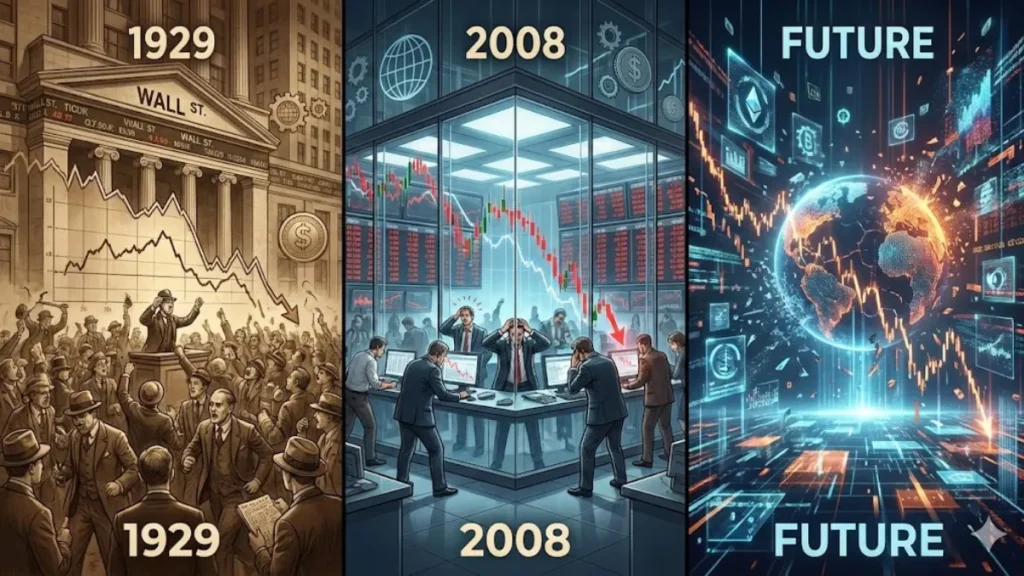
| Factor | 1929 Crash | 2008 Crisis | 2026 Risk Signals |
|---|---|---|---|
| Primary Trigger | Margin speculation | Housing & credit bubble | Tech & AI overvaluation |
| Market Decline | −89% (Dow) | −57% (S&P 500) | Unknown |
| Recovery Time | ~25 years | ~4 years | TBD |
| Unemployment Peak | 25% | ~10% | Uncertain |
| Global Debt | Low | High | Record high |
| Central Bank Response | Minimal | Massive QE | Limited flexibility |
History may not repeat exactly—but every stock market crash follows familiar psychological patterns.
Extended periods of overvaluation often precede every major stock market crash. A deeper breakdown of current valuations and risk indicators is explained in our pillar analysis:
Is the Global Stock Market in a Bubble?
2026 and Beyond: Are the Warning Signs of a Stock Market Crash Visible?

Several indicators suggest rising vulnerability.
Record Global Debt and High Interest Rates
Global debt now exceeds historic levels. Higher interest rates increase pressure on governments, corporations, and households. As debt servicing costs rise, financial stress can amplify market volatility.
AI Hype, Tech Mania, and Valuation Extremes
Artificial intelligence has become the latest growth narrative. While innovation is real, valuations in parts of the tech sector reflect optimism seen before previous bubbles. Similar enthusiasm preceded the dot-com stock market crash.
Geopolitical Tensions and Systemic Fragility
Modern markets are deeply interconnected. Trade conflicts, geopolitical instability, or unexpected economic shocks can rapidly escalate into broader market stress.
Markets price stability. Reality often delivers uncertainty.
In every major crash—1929, 2008, and the upcoming 2026 scenario—the pattern is identical: Smart Money exits early while retail investors buy the top. In 2008, Goldman Sachs shorted subprime mortgages in 2007 while retail investors kept buying housing stocks. Learn how to track Smart Money movements before the next crash instead of becoming their exit liquidity.
The Hidden Victims: Who Pays When Markets Crash?
Every stock market crash disproportionately affects those least prepared. Retail investors often enter late and exit in panic. Institutional investors, armed with liquidity and information, survive—and often thrive.
Crashes widen wealth inequality and reshape social structures long after markets recover.
How Investors Can Prepare for the Next Stock Market Crash
Preparation is the only reliable defense.
Smart Asset Allocation and Risk Management
Diversification reduces vulnerability. Concentrated bets magnify losses during a stock market crash. Balanced portfolios historically recover faster.

Cash, Gold, Bonds: Building a Defensive Portfolio
Cash provides flexibility. Gold has historically preserved value during crises. High-quality bonds can stabilize portfolios when equities fall sharply.
The Psychology of Panic: Avoiding Emotional Mistakes
The largest losses rarely come from crashes themselves—but from panic selling. Markets eventually recover. Investors who remain disciplined are rewarded over time.
The Truth About Market Crashes: What History Really Teaches Us
Markets recover—but not everyone does. Those who understand stock market crash patterns adapt. Those who ignore warning signs repeat costly mistakes.
1929 taught us about leverage.
2008 revealed systemic fragility.
The next cycle will test whether investors truly learned the lesson.
The signs are visible. The only question is whether you are paying attention.
Frequently Asked Questions About Stock Market Crash
What causes a stock market crash?
A stock market crash usually occurs due to a combination of excessive valuations, high leverage, rising interest rates, and sudden loss of investor confidence. Human psychology—fear and greed—plays a major role in accelerating crashes.
Can a stock market crash be predicted in advance?
No one can predict the exact timing of a stock market crash. However, warning signs like asset bubbles, extreme speculation, high debt levels, and tightening monetary policy often appear before major market corrections.
Is a stock market crash in 2026 possible?
While no year can be predicted with certainty, many analysts believe the risk of a stock market crash increases during periods of high global debt, elevated valuations, and economic uncertainty. Investors should focus on preparation rather than prediction.
How should investors protect themselves from a stock market crash?
Investors can reduce risk by diversifying their portfolios, avoiding excessive leverage, maintaining cash reserves, and focusing on long-term investment strategies instead of reacting emotionally during market volatility.
Do stock markets always recover after a crash?
Historically, stock markets have recovered after every major stock market crash. However, recovery timelines vary, and not all investors recover equally. Those who remain disciplined and patient tend to benefit the most over time.
Disclaimer:
This article is for educational purposes only and does not constitute financial advice. Financial markets involve risk, and past performance does not guarantee future results. Always consult a qualified financial advisor before making investment decisions.
🚀 Join MoneyUncut Telegram
Get real-time insights on Global Finance, Stock Market & Economic Trends.
👉 Join NowAbout the Author – Abhishek Chouhan
Abhishek Chouhan is a Global Finance Analyst and Market Researcher with over 15 years of experience studying stock markets, investor behavior, and long-term wealth cycles across the US, Europe, and Asia. He is the founder of MoneyUncut.com, a global financial intelligence platform focused on decoding market psychology, economic trends, and how human behavior shapes financial outcomes.
2 comments
Comments are closed.