
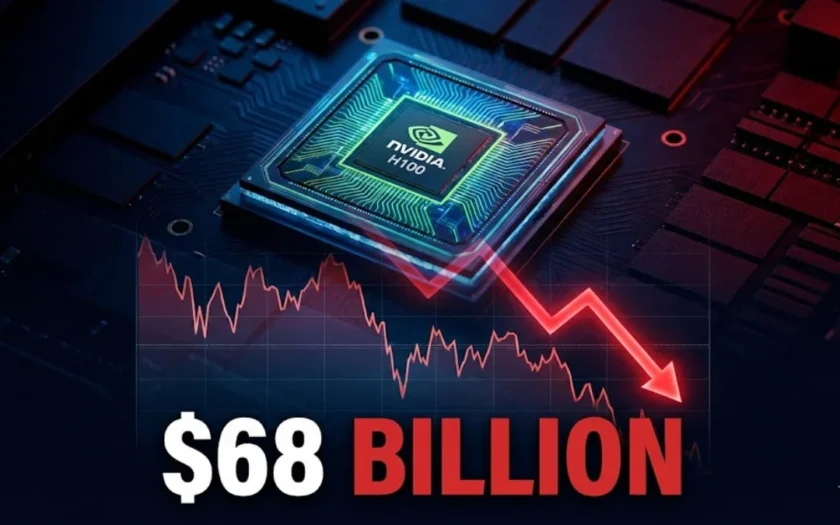
Picture this: A company reports the most profitable quarter in semiconductor history. Record revenue of $68.5 billion. Earnings that demolished every analyst estimate on Wall Street. The CEO stands up and declares that “the agentic AI inflection point has arrived.” The future looks unstoppable.
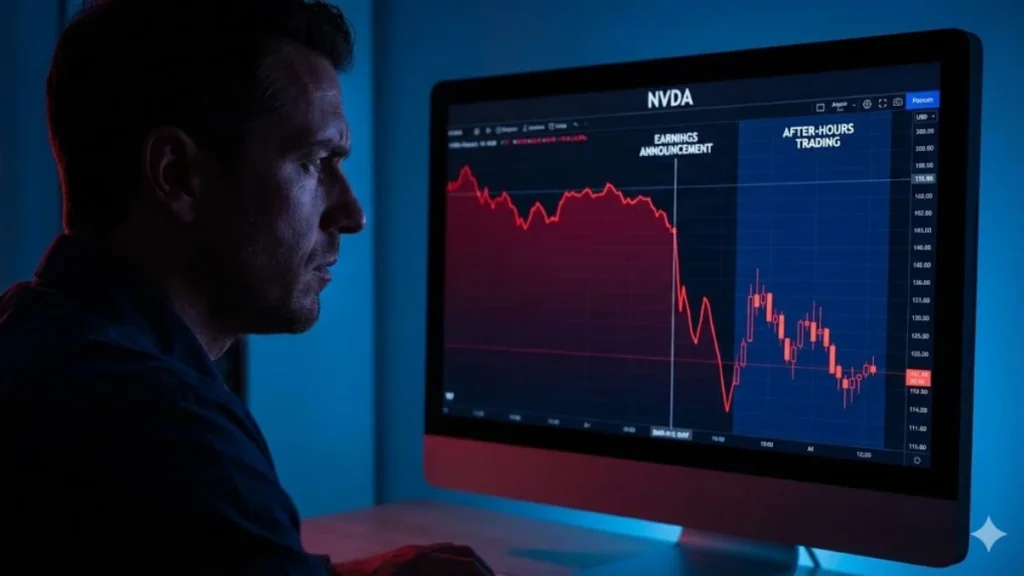
And then — the stock drops 5%.
If that contradiction made you do a double take, you’re asking exactly the right question. Because hidden inside Nvidia’s spectacular earnings report this week is a pattern that repeats every cycle — and most retail investors never see it coming until it’s already cost them money.
This is not a story about Nvidia failing. It’s a story about how markets actually work — and the dangerous gap between what the headlines say and what smart money is actually doing.
The Numbers That Should Have Sent the Stock Soaring
Let’s be clear about what Nvidia actually reported. These are not ordinary numbers.
$68.5 billion in Q4 revenue — a 78% year-over-year increase. Data center revenue alone hit $35.6 billion. The Q1 2026 outlook came in at $43 billion, which again beat what analysts had forecast. Jensen Huang, Nvidia’s CEO, described the current AI environment as entering what he called the “agentic AI inflection point” — a moment where AI systems begin taking autonomous actions, not just responding to prompts.
By every traditional metric, this was a report that should have sent NVDA to new all-time highs by morning.
So why did it fall?
The Real Reason Smart Money Sold Immediately
The answer lies in a concept that professional traders know well and retail investors rarely learn: “Buy the rumor, sell the news.”
Here is exactly what happened. In the weeks and months before Nvidia’s earnings, institutional investors — hedge funds, pension funds, large asset managers — had been quietly building large positions in NVDA. They were betting on strong results. And they were right. The results were extraordinary.
But the moment those results became public knowledge, the edge was gone. The information was now available to everyone. So institutional money did what it always does: it sold the news and locked in its profits — shifting that risk onto retail investors who bought on excitement.
This is not illegal. It is not manipulation. It is simply how professional markets operate. And it is why Google Trends data shows ‘nvda earnings call’ searches surged 650% in the past week — millions of retail investors were chasing information that smart money had already acted on weeks ago.

Nvidia’s Stock Drop Is Not the Biggest Story This Week
Here is something the financial headlines are not connecting for you: Nvidia is not the only stock behaving strangely.
This week’s US market data tells a much bigger story. Search interest for Palantir, Tesla, Amazon, Apple, and Meta has all dropped 30 to 40 percent compared to the previous period. Microsoft searches are down 30 percent. AMD is down 20 percent.
This is not a coincidence. When search interest across an entire sector drops simultaneously — meaning people are not even looking at these stocks — it reflects a deeper sentiment: investor anxiety. People are not excited about markets right now. They are cautious, uncertain, or simply stepping back.
Nvidia’s earnings spike was a momentary burst in that environment. The underlying trend across US tech stocks points to something that every macro investor should be watching closely: the slow deflation of AI-driven optimism.
The sell-off wasn’t limited to Nvidia. This week’s market data shows broad anxiety across tech — Salesforce (CRM) searches surged 190% as its own earnings disappointed, Snowflake stock saw unusual movement, and even the VIX fear index spiked. Meanwhile Bitcoin and Ethereum declined in tandem — a classic risk-off signal suggesting investors are pulling back from speculative assets across the board.
Three Things Jensen Huang Said That Actually Matter
Most coverage focused on the revenue numbers. But Huang’s language during the earnings call deserves more attention from serious investors.
First, he used the phrase “agentic AI inflection point” — which signals that Nvidia’s customers are shifting from buying chips to train AI models to buying chips to run autonomous AI agents at scale. This is a meaningfully larger market. It also means demand for Nvidia’s products could accelerate, not slow down.
Second, the Q1 2026 guidance of $43 billion beat estimates — but only barely. Wall Street had been gradually resetting expectations higher before earnings. A smaller-than-expected beat can feel like a disappointment even when the numbers are objectively strong. This is the “expectations trap” that catches retail investors every time.
Third, Huang’s confidence about the roadmap ahead — including next-generation Blackwell architecture ramp — suggests Nvidia has not reached its ceiling. But that does not mean the stock price reflects fair value today. Revenue growth and stock valuation are two different conversations.
What Should Investors Actually Do Right Now?
The honest answer is that no one can tell you with certainty what NVDA does in the next 30 days. What you can do is think clearly.
If you do not own NVDA: Chasing a stock after a 5% post-earnings drop based on emotion is not a strategy. Understand the valuation first. Nvidia trades at a significant premium. That premium only holds if AI infrastructure spending continues at current rates. If it slows — even slightly — the multiple will compress quickly.
If you already own NVDA: The business remains exceptional. A short-term post-earnings dip after a massive run-up is historically normal. The question is whether your investment thesis — the reason you bought — has changed. If it has not, a 5% move should not change your decision.
For everyone: The real lesson this week is not about Nvidia specifically. It’s about information timing. By the time you read a headline about blowout earnings, smart money has already moved. The edge is not in reacting to news — it’s in understanding the patterns behind the news.
The Bigger Picture — What This Tells Us About AI Stocks in 2026
Nvidia’s results confirmed what many already suspected: the AI infrastructure buildout is real, it is enormous, and it shows no signs of stopping. Hyperscalers — Microsoft, Google, Amazon, Meta — are spending aggressively on data center infrastructure, and the bulk of that spending goes through Nvidia.
But there is a difference between the AI boom being real and every AI stock being fairly valued. The broader market anxiety visible in this week’s data suggests that investors are beginning to ask harder questions: How long can these valuations be sustained? When does the spending cycle peak? What happens if one major hyperscaler cuts its AI capex forecast?
These are exactly the questions that MoneyUncut exists to help you think through — before the market forces the answer on your portfolio.
Key Takeaways
- Nvidia reported $68.5B in Q4 revenue — the strongest quarter in semiconductor history.
- The stock fell 5% because smart money sold on the news after buying the rumor in advance.
- Search data shows 30–40% drops in interest across major tech stocks — a sign of broad market anxiety.
- Jensen Huang’s ‘agentic AI’ framing suggests the next phase of AI demand is larger than the current one.
- The real risk is not Nvidia’s business — it’s the valuation premium in an environment of growing investor caution.
Related Articles
→ Smart Money vs Retail Investors: The Hidden Secrets
→ Is the Global Stock Market in a Bubble?
→ Stock Market Crash 1929 vs 2008 vs 2026
About the Author – Abhishek Chouhan
Abhishek Chouhan is a Global Finance Analyst and Market Researcher with over 15 years of experience studying stock markets, investor behavior, and long-term wealth cycles across the US, Europe, and Asia. He is the founder of MoneyUncut.com, a global financial intelligence platform focused on decoding market psychology, economic trends, and how human behavior shapes financial outcomes.