
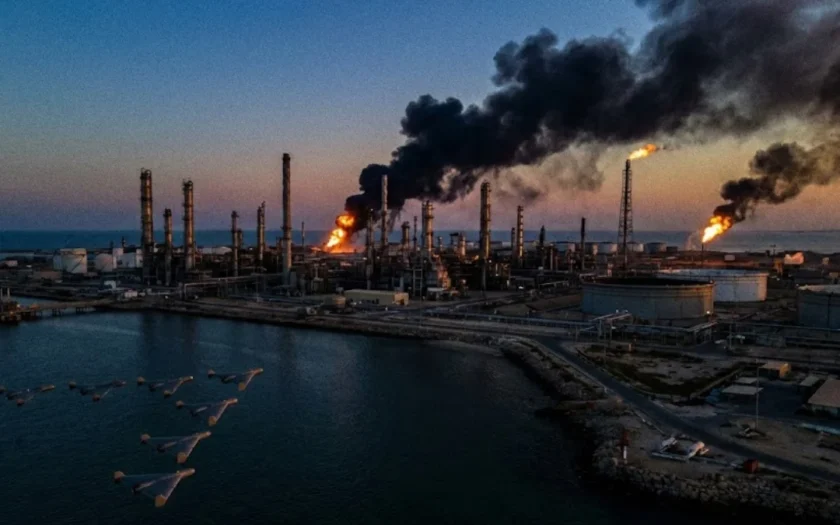
You were finally paying under $3 a gallon.
The AAA national average had just settled at $2.98 per gallon — the lowest in years. Drivers across America were quietly celebrating. Then came Monday morning. One Iranian drone changed everything.
A Shahed-136 drone struck Saudi Aramco’s Ras Tanura refinery — one of the most critical energy facilities on the planet. And the relief you felt at the pump? It may not last the week.
The Target: A Facility Most People Never Heard Of
Ras Tanura isn’t famous. But it quietly powers the world.
Sitting on Saudi Arabia’s eastern coast along the Persian Gulf, this massive complex processes 550,000 barrels of crude oil every single day. It’s one of the world’s largest oil export terminals — sending crude to Europe, Japan, China, and South Korea around the clock.
Think of it as one of the main arteries of global oil supply. Monday morning, that artery took a direct hit.
Markets Didn’t Wait for Confirmation
Within hours of the attack, traders reacted with panic.
Brent crude surged past $80 per barrel — up nearly 10% in a single session. WTI crude jumped close to $73. These aren’t just numbers on a trader’s screen. They are a direct signal of what’s coming at the pump for everyday drivers.
GasBuddy had forecast gas prices to average $2.97 per gallon for all of 2026 — the lowest yearly average since 2020. That forecast was built on one key assumption: the market would “avoid major surprises.”
This is a major surprise.
Why This Feels Different From Past Attacks
This isn’t the first time Aramco has been targeted. In September 2019, drone and missile strikes on the Abqaiq and Khurais facilities knocked out over 5% of the world’s daily oil supply overnight — triggering the single largest one-day oil price spike in history.
Markets recovered then. But the geopolitical backdrop today is far more dangerous.
This attack isn’t isolated. It’s part of a wider wave of Iranian strikes across the Gulf — hitting targets across Bahrain, Kuwait, Qatar, UAE, and Iraq simultaneously. This isn’t one rogue drone. This is a coordinated regional escalation.
The Strait of Hormuz: The Chokepoint Nobody Wants Closed
Here’s what makes this truly alarming.
The Strait of Hormuz — a narrow waterway between Iran and Oman — handles nearly 20% of the world’s daily oil supply. Every tanker leaving the Gulf, including those carrying Ras Tanura crude, passes through it.
Right now, that waterway is under severe threat. Iranian forces have the ability to close or disrupt it. And if they do — even partially — the global oil supply shock would dwarf anything seen since the 1973 oil embargo.
For US drivers, UK motorists, and consumers across Europe — this is the number you should be watching, not just Brent crude.
What Does This Mean for Your Gas Bill?
Let’s be direct.
GasBuddy’s 2026 forecast already warned that geopolitical risks remain one of the key wildcards for fuel prices this year, even as baseline projections pointed lower.
Here’s the chain reaction already in motion:
Iran strikes Ras Tanura → 550,000 barrels offline → Brent crude spikes → Refinery input costs rise → Wholesale gas prices jump → You pay more at the pump — within days.
GasBuddy had projected the national average could briefly rise into the low $3.20 range during spring refinery maintenance season. With this attack, that ceiling could be hit far sooner — and broken.
For UK drivers already paying well above £1.40 per litre, a sustained Brent crude rally above $85 would translate directly into higher forecourt prices before Easter.
3 Things to Watch This Week
1. Aramco’s Damage Assessment Early signals suggest no permanent damage to core production. But every day Ras Tanura stays offline tightens global supply further.
2. The Strait of Hormuz If Iran moves to restrict tanker traffic here, $100 oil isn’t a prediction — it’s a timeline.
3. US and Allied Response Any military escalation in the Gulf will send Brent crude past $85 faster than OPEC can respond.
Bottom Line
GasBuddy had projected that if the market avoids major surprises, sustained averages below $3 per gallon could become commonplace in 2026.
One drone just became that major surprise.
The world was heading toward cheaper fuel. The Iran drone strike on Aramco’s Ras Tanura just put that on hold — and depending on what happens next in the Gulf, the damage could go far deeper than one week’s gas prices.
Watch the pump. Watch the Strait. This story is far from over.
About the Author – Abhishek Chouhan
Abhishek Chouhan is a Global Finance Analyst and Market Researcher with over 15 years of experience studying stock markets, investor behavior, and long-term wealth cycles across the US, Europe, and Asia. He is the founder of MoneyUncut.com, a global financial intelligence platform focused on decoding market psychology, economic trends, and how human behavior shapes financial outcomes.