
The world is entering a phase of heightened systemic stress, and Inequality and Social Polarization sit at the center of this transformation. Identified by global experts as the most interconnected global risk, this challenge does not remain confined to social outcomes alone. It reshapes economic resilience, political stability, and institutional trust across regions.
What makes Inequality and Social Polarization uniquely dangerous is its ability to compound other risks simultaneously. Economic shocks hit unevenly, governance weakens, and societal cohesion fractures, creating a feedback loop that accelerates instability rather than absorbing it.
Source: Global Risks Report 2026, Chapter 1, pages 7–12; Figure 6, page 11
This risk sits within a broader set of systemic threats outlined in the Global Risks Report 2026.
Why Inequality and Social Polarization Anchor the Global Risk Landscape
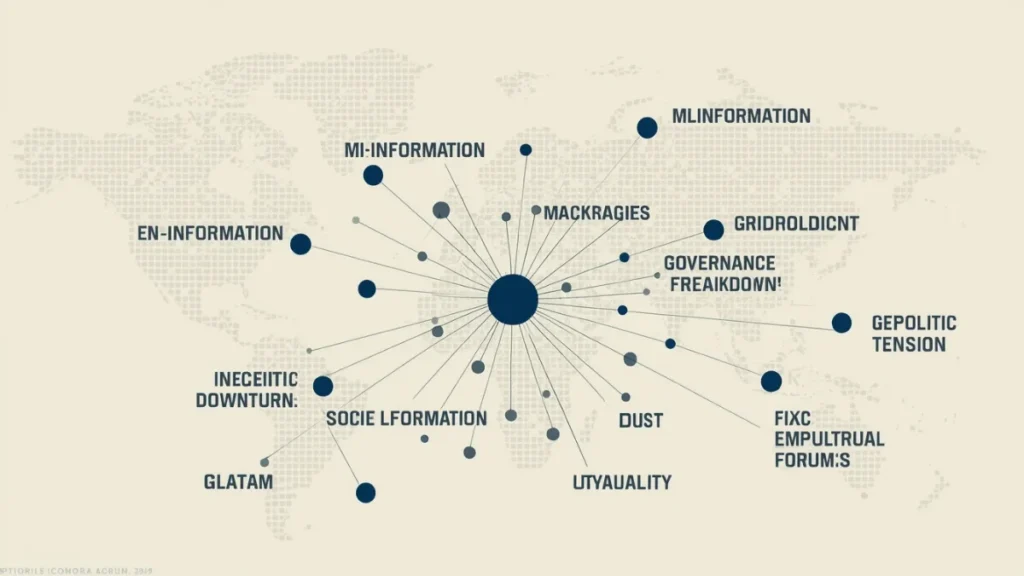
Unlike single-domain risks, Inequality and Social Polarization function as systemic amplifiers. They increase the severity, speed, and persistence of other global threats. When trust erodes and opportunity concentrates, societies lose their shock-absorption capacity.
This explains why inequality consistently appears as both a cause and a consequence within global risk interconnection maps.
Rising inequality often pushes governments toward protectionist and confrontational strategies, reinforcing trends seen in Geoeconomic Confrontation.
A Risk That Multiplies Other Risks
Economic downturns become harder to reverse when income and opportunity gaps widen. Social unrest becomes more frequent when institutions are perceived as serving only a few. Political systems struggle to govern effectively when legitimacy erodes.
This multiplier effect, not its standalone ranking, makes Inequality and Social Polarization the most strategically dangerous risk.
Source: Global Risks Report 2026, Chapter 1, pages 10–14; Figure 3, page 9
The Economic Divide Is No Longer Cyclical
Recent economic cycles show a persistent divergence between asset growth and wage growth. Capital accumulation increasingly benefits a narrow segment of society, while large portions of the workforce experience stagnant or declining purchasing power.
This divergence is structural, not temporary.
The Rise of a Permanent K-Shaped Economy
High-skill, high-productivity segments capture gains from technological acceleration. Low-productivity segments face wage pressure, job displacement, and declining mobility. Over time, this creates a hardened economic divide that policy interventions struggle to reverse.
As opportunity narrows, dissatisfaction widens — directly feeding Inequality and Social Polarization.
Source: Global Risks Report 2026, Chapter 2.3, pages 36–37
Social Polarization and the Breakdown of Trust
Social polarization reflects more than ideological disagreement. It signals a breakdown in trust between citizens and institutions. Narratives framing society as “elites versus the public” thrive when people believe the system no longer works for them.
From Alienation to Instability
Economic exclusion fuels political alienation. Political alienation increases susceptibility to extremist narratives. These narratives weaken consensus, making coordinated responses to crises increasingly difficult.
Once entrenched, Inequality and Social Polarization undermine democratic resilience itself.
Source: Global Risks Report 2026, Chapter 2.3, pages 32–33
As societies fracture internally, support for global cooperation weakens, accelerating the End of Multilateralism.
Technology Accelerates Existing Divides
Technology does not create inequality, but it magnifies it. Digital platforms amplify misinformation in already polarized environments, reinforcing distrust and fragmenting shared reality.
AI, Access, and Unequal Outcomes
Access to advanced technology increasingly determines economic opportunity. Regions and populations with limited digital infrastructure fall further behind, while early adopters consolidate advantage. Algorithmic systems trained on biased data risk institutionalizing inequality at scale.
In this environment, Inequality and Social Polarization and misinformation reinforce each other.
Source: Global Risks Report 2026, Chapter 2.7, pages 61–62
Key Interconnections Shaping Systemic Risk
| Risk Category | How Inequality Intensifies the Risk | Systemic Impact |
|---|---|---|
| Economic downturn | Unequal shock absorption | Prolonged instability |
| Societal polarization | Trust erosion | Governance paralysis |
| Misinformation | Fragmented information ecosystems | Radicalization |
| Economic opportunity | Mobility barriers | Persistent inequality |
| Public infrastructure | Uneven investment | Social fragmentation |
This structure explains why addressing symptoms without tackling inequality fails to stabilize the system.
Source: Global Risks Report 2026, Chapter 1, pages 16–19; Figure 17, page 19
Labor Markets Under Structural Pressure
Workforce disruption increasingly reflects structural imbalance rather than temporary adjustment. Job displacement often outpaces reskilling, leaving large segments of society exposed to long-term insecurity.
When upward mobility pathways collapse, frustration accumulates, reinforcing Inequality and Social Polarization.
Source: Global Risks Report 2026, Chapter 2.7, pages 61–63
Fiscal Constraints Limit Policy Responses
Rising debt burdens restrict governments’ ability to address inequality effectively. As resources are diverted toward debt servicing, investments in education, healthcare, and social protection face pressure.
This fiscal squeeze reduces policy flexibility precisely when social cohesion requires reinforcement.
Source: Global Risks Report 2026, Chapter 2.4, pages 40–42
Breaking the Feedback Loop
Long-term stability depends on rebuilding trust and restoring opportunity. Multi-stakeholder engagement consistently emerges as the most effective approach to reducing societal polarization.
Digital literacy, institutional transparency, and inclusive growth strategies are not optional — they are systemic risk controls.
Source: Global Risks Report 2026, Chapter 2.3, pages 38–39
Conclusion: Inequality Is a Stability Issue
Inequality and Social Polarization are not moral debates; they are structural stability challenges. Left unaddressed, they magnify every other global risk — from economic volatility to political fragmentation.
The path forward demands coordinated action across governments, businesses, and civil society. Societies that reduce inequality expand their capacity to manage risk. Those that ignore it make every future crisis harder to contain.
FAQs
Can Inequality and Social Polarization be reversed?
Yes, but only through long-term systemic action. Policies focused on inclusive growth, digital literacy, institutional transparency, and equitable access to education and healthcare are critical to rebuilding trust and breaking the feedback loop of polarization.
Disclaimer: This article is based on interpretation of the World Economic Forum’s Global Risks Report 2026 and is intended for educational purposes only.
About the Author – Abhishek Chouhan
Abhishek Chouhan is a Global Finance Analyst and Market Researcher with over 15 years of experience studying stock markets, investor behavior, and long-term wealth cycles across the US, Europe, and Asia. He is the founder of MoneyUncut.com, a global financial intelligence platform focused on decoding market psychology, economic trends, and how human behavior shapes financial outcomes.
2 comments