
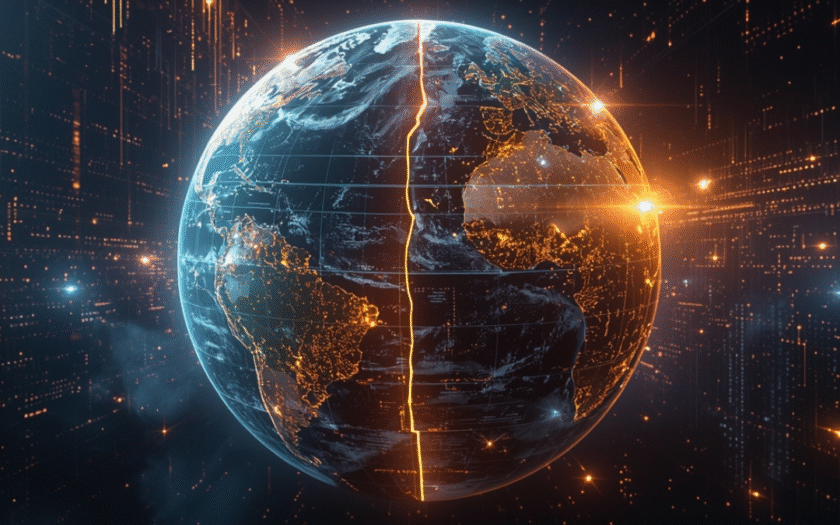
The world is entering a phase where power is no longer stable, cooperation is weakening, and global rules are losing authority. No one can clearly predict whether the future will be dominated by chaos or coordination. The real question behind the Global Political Outlook 2036 is simple: are we moving toward irreversible fragmentation, or the birth of a fundamentally new world order?
This is not a theoretical debate anymore. Political risks, economic conflicts, technological rivalry, and social polarization are already reshaping how nations interact, trade, and govern. The coming decade will decide whether the global system collapses into competing blocs or reorganizes into a new form of collective order.
This article is part of our Global Risks Report 2026 Explained: What the World Economic Forum Is Warning the World About series, where we analyze the key global risks shaping the future.
The Age of Competition Has Already Begun
The defining feature of the current decade is not growth or globalization. It is competition. Governments are increasingly using trade, finance, technology, and regulation as strategic weapons rather than neutral tools. Economic policies are no longer just about prosperity; they are instruments of geopolitical power.
The Global Political Outlook 2036 reflects a world where rivalry replaces cooperation. Multilateral institutions that once stabilized global relations are losing influence. Instead of shared rules, nations are prioritizing national security, industrial self-sufficiency, and strategic control over resources.
This shift signals the end of the post-Cold War consensus. Power is now distributed across multiple centers, creating a multipolar system without strong coordination mechanisms. In such an environment, conflict becomes easier, and global problem-solving becomes harder.
Source: Global Risks Report 2026, World Economic Forum, Page 7, Figure 1
Geoeconomic Confrontation: The New Battlefield
When economics replaces warfare
Geoeconomic confrontation has emerged as the most severe short-term global risk. Instead of military invasions, countries are now using sanctions, tariffs, export controls, and investment restrictions to weaken rivals.
This marks a structural transformation. Economic interdependence was once seen as a stabilizing force. Today, it is viewed as a vulnerability. Supply chains are being reshaped, strategic industries are being protected, and technology is being weaponized.
The Global Political Outlook 2036 suggests that economic conflict will be the dominant form of power struggle. This creates a world where growth is slower, trust is lower, and global markets are fragmented into competing blocs.
To understand how sanctions, trade wars, and supply chain weaponization are reshaping global power, read our detailed analysis on What Is Geoeconomic Confrontation? Why It Is the Top Global Risk in 2026.
Geoeconomics does not create visible wars, but it generates silent instability. It weakens institutions, amplifies inequality, and increases the risk of systemic crises across finance, energy, and technology.
Source: Global Risks Report 2026, World Economic Forum, Page 8, Figure 2
The Collapse of Multilateralism
Why global cooperation is breaking down
Multilateralism was the foundation of global governance for decades. Institutions like the UN, WTO, IMF, and World Bank were designed to manage conflict and coordinate growth. That system is now under pressure.
Rising nationalism, declining trust, and ideological polarization have made collective decision-making increasingly ineffective. Countries are withdrawing from global commitments and pursuing unilateral strategies.
The Global Political Outlook 2036 highlights a critical reality: cooperation is no longer automatic. It must be negotiated in a world where power is fragmented and interests are misaligned.
We explore this breakdown of global institutions in depth in End of Multilateralism: Why Global Cooperation Is Breaking Down, where we analyze how the rules-based order is losing relevance.
Without strong multilateral frameworks, global challenges such as climate change, pandemics, cyber threats, and financial instability become harder to manage. The result is not order, but overlapping crises.
Source: Global Risks Report 2026, World Economic Forum, Page 12, Figure 9
Table: Competing Futures for the Global System (2036)
| Scenario | Core Characteristics | Political Outcome |
|---|---|---|
| Fragmented World | Nationalism, trade wars, weak institutions | High instability |
| Bipolar Order | Two dominant superpowers | Strategic deadlock |
| Multipolar Chaos | Many power centers, no coordination | Systemic risk |
| New World Order | Reformed institutions, adaptive cooperation | Conditional stability |
This comparison shows that fragmentation is the default trajectory unless active reforms reshape global governance.
The table makes one reality clear: stability is no longer guaranteed by structure. It depends entirely on political choices made today.
Inequality and Social Polarization
The hidden driver of global instability
Inequality is the most interconnected global risk. It fuels political extremism, weakens democratic systems, and undermines social cohesion. When economic systems fail to deliver inclusive growth, political legitimacy collapses.
The Global Political Outlook 2036 shows that inequality is not just a social problem. It is a geopolitical risk. Societies divided by wealth, identity, and opportunity become more volatile, more radical, and more vulnerable to manipulation.
For a deeper breakdown of how inequality connects with political instability, technology, and economic risk, see Inequality and Social Polarization: The Most Interconnected Global Risk.
Technological disruption is amplifying this divide. Automation, artificial intelligence, and digital platforms are reshaping labor markets faster than political systems can adapt. The result is a permanent state of social tension.
Polarized societies cannot sustain stable global cooperation. They prioritize internal survival over external collaboration. This creates a feedback loop where domestic crises translate into international disorder.
Source: Global Risks Report 2026, World Economic Forum, Page 10, Figure 6
Technology and Power in 2036
AI, cyber risks, and strategic dominance
Technology is no longer neutral. Artificial intelligence, quantum computing, and digital infrastructure are becoming tools of strategic control. Nations that dominate these systems will shape global rules.
Cyber insecurity and misinformation are already destabilizing political systems. Elections, financial markets, and public opinion are increasingly influenced by algorithmic power.
The Global Political Outlook 2036 suggests that technological leadership will replace military strength as the primary source of global dominance. Power will belong to those who control data, networks, and digital platforms.
This creates a new form of hierarchy where political influence is embedded in code, infrastructure, and information flows.
Source: Global Risks Report 2026, World Economic Forum, Page 9, Figure 5
Fragmentation or a New World Order?
The future is not predetermined. The world is standing at a structural crossroads. One path leads toward fragmentation: competing blocs, economic warfare, technological rivalry, and declining trust.
The other path leads toward a new world order: not a return to old systems, but a restructured form of global governance based on adaptive cooperation, decentralized power, and strategic coordination.
The Global Political Outlook 2036 makes one truth unavoidable: the next world order will not emerge automatically. It will be designed through political decisions, institutional reforms, and collective action.
History shows that global systems do not collapse overnight. They decay gradually until a crisis forces transformation. The current decade is that crisis phase.
Conclusion: The Future Is Being Designed Now
The world of 2036 will not be defined by ideology, geography, or even economics. It will be defined by governance. Either nations rebuild trust and redesign cooperation, or fragmentation becomes permanent.
The Global Political Outlook 2036 is not a forecast. It is a warning. Power is shifting, institutions are weakening, and social contracts are breaking. The next decade will determine whether humanity enters a new age of coordinated stability or a long cycle of systemic disorder.
The future is not waiting to be predicted. It is already being constructed through the choices made today.
FAQs – Global Political Outlook 2036
What is meant by Global Political Outlook 2036?
Global Political Outlook 2036 refers to a forward-looking analysis of how global power structures, political systems, and international cooperation are expected to evolve by the year 2036. It focuses on trends such as geopolitical fragmentation, technological dominance, economic rivalry, and the future of global governance.
Why is Global Political Outlook 2036 important for understanding future risks?
The Global Political Outlook 2036 is important because it highlights how political decisions made today will shape long-term global stability. It helps governments, businesses, and individuals anticipate risks related to economic conflict, social polarization, cyber threats, and the breakdown of multilateral institutions.
Does Global Political Outlook 2036 predict a new world order?
The Global Political Outlook 2036 does not offer a single fixed prediction but outlines multiple possible scenarios. These range from a fragmented world dominated by rival blocs to a restructured global order based on adaptive cooperation and new forms of international coordination.
How does inequality affect Global Political Outlook 2036?
Inequality plays a central role in the Global Political Outlook 2036 because it drives political instability, weakens democratic systems, and increases social polarization. High inequality reduces trust in institutions and makes societies more vulnerable to extremism and geopolitical manipulation.
What role will technology play in Global Political Outlook 2036?
Technology is a key driver in the Global Political Outlook 2036. Artificial intelligence, cyber systems, data control, and digital infrastructure will shape future power structures. Nations that dominate these technologies are likely to influence global rules, economic systems, and political narratives.
Disclaimer
This article is for educational and informational purposes only. It does not constitute political, economic, or strategic advice. The analysis is based on publicly available global risk research and represents an independent interpretation for learning and discussion.
About the Author – Abhishek Chouhan
Abhishek Chouhan is a Global Finance Analyst and Market Researcher with over 15 years of experience studying stock markets, investor behavior, and long-term wealth cycles across the US, Europe, and Asia. He is the founder of MoneyUncut.com, a global financial intelligence platform focused on decoding market psychology, economic trends, and how human behavior shapes financial outcomes.