
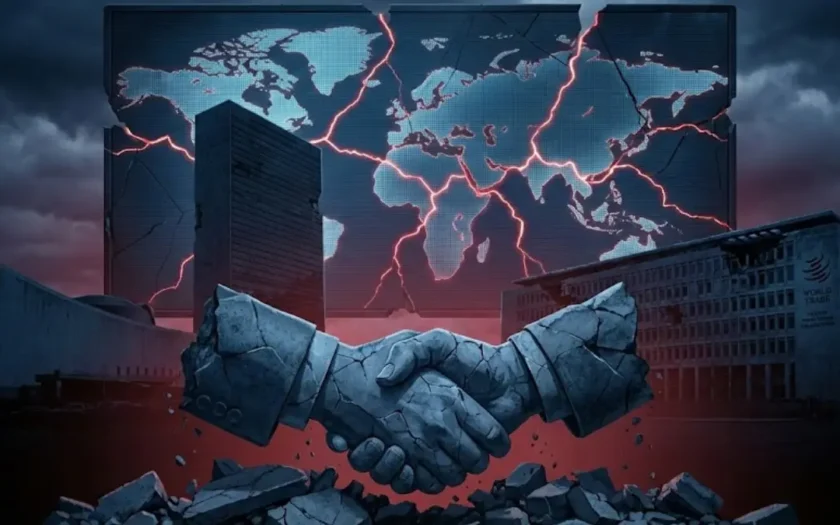
The end of multilateralism is not a distant threat. It is happening right now. The World Economic Forum’s Global Risks Report 2026 confirms what many suspected: the rules-based international order is collapsing. Only 6% of global experts expect the US-led system to recover. The rest see fragmentation, competition, and chaos.
This breakdown did not happen overnight. For decades, multilateral institutions kept the world stable. The WTO resolved trade disputes. The UN mediated conflicts. International treaties governed everything from climate change to nuclear weapons. That era is over.
Today, countries are turning inward. Trust is dead. Cooperation is a relic. The rise of geoeconomic confrontation is both cause and consequence of this collapse. Nations now weaponize trade, sanctions, and technology instead of negotiating through global bodies.
Source: Global Risks Report 2026, Chapter 2.2: Multipolarity without multilateralism, pages 24-31; Figure 9, page 13
The collapse of multilateralism — highlighted in the “End of Multilateralism” analysis — is a central theme in the Global Risks Report 2026, showing how weakening cooperation exacerbates other systemic risks like inequality, economic fragmentation, and geopolitical tensions.
The Numbers Don’t Lie: Multilateralism Is Dying
The data is brutal. According to the WEF survey, 68% of respondents expect a multipolar or fragmented order over the next decade. This is not speculation. It is the new reality.
The World Trade Organization, once the backbone of global commerce, is broken. Dispute cases have dropped to one-third of pre-2019 levels. Why? Because the Appellate Body—the court that enforces trade law—has been disabled since 2019. Countries stopped trusting the system.
The rule of law is collapsing too. The World Justice Project reports that 68% of 143 countries saw their rule of law decline in 2025. This is not gradual erosion. It is a sharp, accelerating fall.
Even worse, conflicts are at historic highs. There were 61 active conflicts across 36 countries in 2024. That makes it the fourth-deadliest year since the Cold War ended. Key conflict-risk indicators are at their worst levels since World War II.
Source: Global Risks Report 2026, pages 25-27; Figure 9, page 13; Figure 27, page 30; World Justice Project Rule of Law Index 2025 cited on page 30
Why Multilateralism Is Breaking Down
The Trust Vacuum
The end of multilateralism has clear drivers. First, geoeconomic confrontation is destroying trust. Nations are using tariffs, sanctions, and export controls as weapons. The WTO cannot stop them. Neither can the UN.
Second, multilateral institutions are losing funding. Deep budget cuts are forcing international organizations to scale back development and aid programs. Governments are choosing national priorities over global cooperation.
New Power Blocs Emerging
Third, new power blocs are forming. Countries that reject the unipolar world order are building their own multilateral entities. These new institutions do not subscribe to Western rules or norms.
Fourth, domestic politics are shifting. In many democracies, citizens feel excluded from decision-making. They see multilateral agreements as benefiting elites while hurting ordinary workers. This fuels nationalist movements that reject international cooperation.
Source: Global Risks Report 2026, Chapter 2.2, pages 24-31; Key Findings section, pages 7-9
What Happens When Cooperation Ends
More Conflicts, Less Security
The end of multilateralism means more wars. Without neutral bodies to mediate disputes, countries resort to force. Several dozen nations are experiencing worsening relations with neighbors. State fragility is spreading—even previously stable democracies are at risk.
Military spending is surging. Nations are expanding defense capabilities and developing new weapons, including AI-powered systems. The risk of miscalculation is rising.
Source: Global Risks Report 2026, pages 27-28; Fund for Peace Fragile States Index 2024 cited on page 29
Economic Fragmentation
Global supply chains are fracturing. The 2024 Panama Canal drought and Rhine River low water levels showed how vulnerable interconnected systems are. Now add deliberate economic warfare to the mix.
Countries are stockpiling critical resources. Export controls are expanding to cover AI, semiconductors, biotech, quantum computing, drones, and rare earths. Investment screening is becoming stricter across G20 nations.
| Indicator | Status | Impact |
|---|---|---|
| WTO dispute cases | Down 67% since 2019 | Trade conflicts unresolved |
| Countries with declining rule of law | 68% (98 of 143) | Legal systems weakening |
| Active global conflicts (2024) | 61 across 36 countries | 4th deadliest year since Cold War |
| Experts expecting fragmented order | 68% | Cooperation nearly impossible |
| Multilateral institution funding | Deep cuts reported | Development aid shrinking |
This table shows the end of multilateralism in hard numbers. Every metric points in the same direction: breakdown.
Source: Global Risks Report 2026, pages 25-28; Figure 23, page 25; Figure 24, page 26; OECD and UNCTAD G20 Investment Measures Report cited on page 25
Climate and Health Crises Worsen
Global challenges require global solutions. Climate change does not respect borders. Pandemics spread worldwide. But without multilateral cooperation, these problems become unsolvable.
The report notes that environmental risks are being deprioritized despite worsening long-term outlooks. Why? Because countries are focused on immediate economic and security threats. Long-term global goals take a backseat to short-term national interests.
Source: Global Risks Report 2026, Chapter 1, pages 10-11; Figure 4, page 9; Figure 16, page 19
The Vicious Cycle: Geoeconomic Confrontation Feeds the Breakdown
The end of multilateralism and geoeconomic confrontation reinforce each other. Weak multilateral rules give countries freedom to use economic weapons. Those economic weapons further erode trust in international institutions. The cycle deepens.
Countries that once relied on the WTO now impose unilateral tariffs. Nations that trusted UN peacekeeping now build their own military alliances. The system designed to prevent conflict is now fueling it.
Source: Global Risks Report 2026, Chapter 2.2, pages 24-28; Figure 26, page 28
What Comes Next: The Multipolar Fragmented Order
The end of multilateralism does not mean the end of all cooperation. It means cooperation looks different. Regional blocs will replace global institutions. Bilateral deals will replace multilateral treaties. Power, not rules, will govern international relations.
Some countries will align with the United States. Others will align with China. Many will try to balance both. But this balancing act is dangerous. Countries that fail to pick sides risk being squeezed by both.
The next decade will be defined by competition, not collaboration. Global risks like climate change, pandemics, and technological disruption will be harder to manage. The world will be less stable, less predictable, and more dangerous.
Source: Global Risks Report 2026, Chapter 1: The Age of Competition, pages 14-23; Figure 9, page 13
Conclusion: The Age of Competition Has Arrived
The end of multilateralism marks the end of an era. The rules-based international order that governed the world for 80 years is gone. In its place: fragmentation, rivalry, and nationalism.
The data is clear. The trends are undeniable. Multilateral institutions are weakening. Conflicts are rising. Trust is disappearing. Countries are choosing self-interest over collective action.
This is not a temporary phase. The shift is structural. The age of competition has arrived. Nations that adapt will survive. Those that cling to the old order will fall behind.
The end of multilateralism is not the end of the world. But it is the end of the world we knew.
Reference :
FAQs
What does the “End of Multilateralism” mean in global politics?
The end of multilateralism refers to the decline of global cooperation through international institutions like the UN and WTO, where countries increasingly prioritize national interests over collective rules, leading to a fragmented and competitive world order.
Why are multilateral institutions like the WTO and UN weakening?
Multilateral institutions are weakening due to loss of trust, funding cuts, political polarization, and the rise of geoeconomic confrontation, where nations prefer unilateral actions such as sanctions and tariffs instead of negotiated solutions.
How does the end of multilateralism increase global conflict?
Without neutral platforms for dispute resolution, countries rely more on military power and economic coercion. This increases the risk of wars, miscalculations, and long-term instability across regions.
What is a fragmented multipolar world order?
A fragmented multipolar world order is a system where multiple power centers (like the US, China, and regional blocs) compete without shared global rules, replacing cooperation with strategic rivalry and power-based alliances.
Disclaimer: This article is based on data from the World Economic Forum’s Global Risks Report 2026 and related authoritative sources. It is intended for informational purposes only and does not constitute professional advice. Readers should conduct their own research and consult experts before making decisions based on this content.
About the Author – Abhishek Chouhan
Abhishek Chouhan is a Global Finance Analyst and Market Researcher with over 15 years of experience studying stock markets, investor behavior, and long-term wealth cycles across the US, Europe, and Asia. He is the founder of MoneyUncut.com, a global financial intelligence platform focused on decoding market psychology, economic trends, and how human behavior shapes financial outcomes.
4 comments