
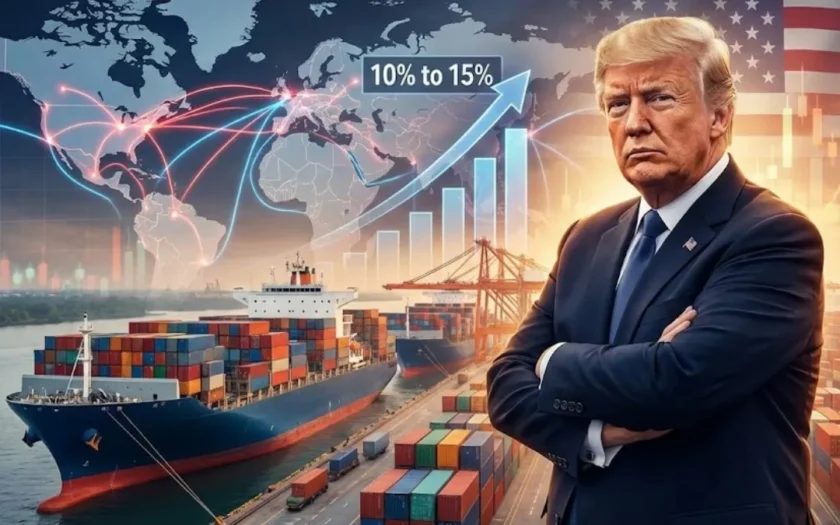
The Trump 15 percent global tariff announcement dropped like a bomb on Saturday, February 21, 2026 — exactly 24 hours after the Supreme Court destroyed the legal foundation of his entire trade agenda. Instead of retreating, Trump went to the maximum.
One day earlier, the Supreme Court — in a devastating 6-3 ruling — declared that Trump’s sweeping IEEPA-based
“reciprocal” tariffs were illegal. His response? He signed an executive order imposing a 10% global tariff under a completely different law. Then, before the ink was dry, he cranked it up to the Trump 15 percent global tariff — the absolute legal ceiling allowed under Section 122 of the Trade Act of 1974.
This is not a president who accepts defeat. This is a president who weaponizes it.
What Exactly Happened? The Timeline That Shook Global Trade
Let’s break this down, because the speed at which this unfolded is staggering.
Friday, February 20, 2026 — The Supreme Court Strikes
The US Supreme Court delivered its ruling: Trump’s use of the International Emergency Economic Powers Act (IEEPA) to impose tariffs was unconstitutional.
The decision was written by Chief Justice John Roberts, who didn’t mince words:
“The Framers did not vest any part of the taxing power in the Executive Branch.”
Translation: You’re the President, not Congress. You don’t get to create taxes.
The court upheld lower court rulings — including from the US Court of International Trade — that had already found Trump’s tariff mechanism illegal. The IEEPA, a 1977 law designed for national emergencies, was never meant to be a tariff weapon. Trump used it anyway. The court said no.
The vote: 6-3. Not even close.
Friday Evening — Trump Strikes Back
Most presidents would have called their lawyers, issued a calm statement, and started planning their next move behind closed doors.
Trump went to war.
He called the justices “a disgrace to our nation.” He signed an executive order imposing a 10% global tariff under an entirely different law — Section 122 of the Trade Act of 1974.
This statute allows the President to impose tariffs of up to 15% for 150 days to address trade deficits. It has never been used for this purpose before. Trump just made history — again.
The tariffs were set to take effect on February 24, 2026, at 12:01 a.m. ET — the same day as his State of the Union address.
Saturday, February 21, 2026 — The Escalation
If 10% was the warning shot, 15% was the declaration.
Trump took to Truth Social and posted what might be the most aggressive trade statement any sitting president has ever made:
“Please let this statement serve to represent that I, as President of the United States of America, will be, effective immediately, raising the 10% Worldwide Tariff on Countries, many of which have been ‘ripping’ the U.S. off for decades, without retribution (until I came along!), to the fully allowed, and legally tested, 15% level.”
He called the Supreme Court’s ruling “ridiculous, poorly written, and extraordinarily anti-American.”
Read that again. The President of the United States just called a Supreme Court decision — issued by a court that includes three justices he personally appointed — anti-American.
This is where we are.
Why 15%? The Legal Loophole Trump Is Exploiting
Here’s what makes this move both brilliant and terrifying.
Section 122 of the Trade Act of 1974 gives the President limited but real authority:
| Parameter | Detail |
|---|---|
| Maximum tariff rate | 15% |
| Duration without Congress | 150 days |
| Original purpose | Address large and serious trade deficits |
| Times previously used for tariffs | Zero |
| Congressional approval needed after 150 days | Yes |
Trump went straight to the maximum. He didn’t start at 11% or 12%. He went to 15% — the legal ceiling — because that’s how Trump operates. If there’s a limit, he hits it.
But here’s the catch: after 150 days, Congress has to approve any extension. And right now, even some Republicans are uneasy about his trade agenda. Getting that approval is not guaranteed.
The clock starts ticking on February 24. By late July 2026, Trump will either need congressional support or a new legal strategy.
Bet on him finding one.
The Supreme Court Ruling: Why It Actually Matters
Let’s not gloss over what the court actually did, because it’s historic.
The Core Issue
When Trump launched his tariffs on “Liberation Day” in April 2025, he used the IEEPA to impose duties ranging from 10% to 50% on dozens of countries. The argument was simple: trade deficits are a national emergency, and the President has emergency powers to address them.
The Supreme Court disagreed — emphatically.
The Constitutional Argument
The Constitution is clear: Article I, Section 8 gives Congress — not the President — the power to lay and collect taxes, duties, and tariffs. The Founders designed it that way deliberately. They didn’t want a king setting tax rates.
Chief Justice Roberts’ opinion drove this point home. The IEEPA was designed for freezing assets and blocking transactions during genuine national emergencies. It was never intended as a backdoor tariff authority.
The Vote Breakdown
- Majority (6): Struck down the tariffs as exceeding presidential authority
- Dissent (3): Argued for broader executive trade powers
The fact that even some conservative justices sided against Trump speaks volumes about how far he pushed the legal boundaries.
The $170 Billion Question: What About Refunds?
Here’s something that most coverage is burying, but it could be the biggest financial story of the year.
The Supreme Court ruled Trump’s IEEPA tariffs were illegal. That means every dollar collected under those tariffs — potentially over $170 billion — was collected without legal authority.
More than 1,500 companies have already filed lawsuits in trade court, positioning themselves for exactly this moment. They want their money back.
The court’s ruling, however, did not address refunds directly. It punted that question to lower courts. This means:
- Years of litigation ahead
- Massive potential government liability
- Companies sitting on claims worth billions
Treasury Secretary Scott Bessent tried to calm markets by saying tariff revenue would remain “virtually unchanged” in 2026. But that’s an optimistic spin on a situation that is anything but settled.
What Stays in Place? The Tariffs That Survived
Not everything was struck down. Here’s what’s still standing:
✅ Still Active
- Section 301 tariffs (targeting specific trade violations, particularly against China)
- Section 232 tariffs (national security tariffs on steel and aluminum)
- New 15% global tariff under Section 122 (just announced)
- USMCA-related exemptions for certain US-Mexico-Canada goods
❌ Struck Down
- All IEEPA-based “reciprocal” tariffs (the Liberation Day tariffs)
- Country-specific tariff rates ranging from 10% to 50%
🔄 Coming Soon
Trump has ordered the US Trade Representative to launch new Section 301 investigations on an accelerated timeline. These would target:
- Industrial overcapacity
- Forced labor practices
- Pharmaceutical pricing discrimination
- Digital services taxes
- Ocean pollution
- Trade in seafood, rice, and other products
US Trade Representative Jamieson Greer confirmed these probes would cover “most major trading partners.”
The goal is clear: rebuild the tariff wall using legally bulletproof methods. It will take longer, but Trump has shown he’s willing to play the long game when forced to.
The State of the Union Factor
The timing of all this is not accidental.
Trump’s State of the Union address is scheduled for Tuesday, February 24 — the same day the new tariffs take effect. This gives him a massive national stage to:
- Frame the Supreme Court as the enemy of American workers
- Present himself as the fighter who won’t back down
- Rally public support for his trade agenda
- Pressure Congress to back his tariff extensions
If you think Trump won’t use that speech to go after the Supreme Court, you haven’t been paying attention for the last decade.
Global Impact: Who Gets Hit Hardest?
A 15% tariff on everything entering the United States is not a policy detail. It’s an earthquake.
🌏 Most Affected Regions
| Region | Key Concern |
|---|---|
| China | Already facing Section 301 tariffs + new 15% baseline |
| European Union | Auto exports, agricultural products heavily impacted |
| Southeast Asia | Manufacturing hubs (Vietnam, Thailand) lose cost advantage |
| Japan & South Korea | Electronics, auto parts face higher costs |
| India | IT services may escape, but goods exports hit hard |
| Mexico & Canada | Partially protected by USMCA, but not entirely |
Consumer Impact
Let’s be direct: Americans will pay more for almost everything.
Every imported good — from electronics to clothing to food ingredients — will carry a 15% surcharge. Companies will absorb some of that cost. The rest goes straight to your wallet.
Inflation, which had been cooling, could spike again. The Federal Reserve will be watching closely.
The Bigger Picture: A Constitutional Crisis in Slow Motion
What’s happening right now goes beyond trade policy. This is a fundamental test of how American government works.
The Constitution says Congress controls tariffs.
The Supreme Court just confirmed that.
The President is saying he’ll find other ways to do it anyway.
This isn’t about whether tariffs are good or bad economic policy. Reasonable people disagree on that. This is about whether the President can unilaterally restructure global trade without congressional approval.
Trump’s use of Section 122 is legally untested in this context. No president has ever used it to impose global tariffs. It will almost certainly be challenged in court. And when it is, we’ll be right back where we started — with judges deciding how much power the President really has.
The cycle continues.
What Happens Next?
Here’s the roadmap for the coming weeks and months:
Immediate (Next 7 Days)
- ✅ 15% global tariffs take effect (Feb 24)
- ✅ State of the Union address (Feb 24)
- ⏳ Market reaction (expect volatility)
- ⏳ New legal challenges likely filed
Short-Term (1-3 Months)
- Section 301 investigations launched
- Congressional debates on tariff authority
- Refund lawsuits move forward in trade courts
- Potential retaliatory tariffs from trading partners
Medium-Term (3-6 Months)
- 150-day clock expires on Section 122 tariffs (late July)
- Congress must vote to extend or tariffs expire
- Section 301 findings could enable new targeted tariffs
- Possible trade negotiations with key partners
Long-Term (6-12 Months)
- New tariff framework established (or not)
- Impact on midterm election positioning
- Potential new legislation on presidential trade authority
- WTO challenges from trading partners
The Bottom Line
Donald Trump just lost the biggest legal battle of his second term. The Supreme Court told him — in unmistakable terms — that his tariffs were illegal.
His response was to impose new tariffs immediately, raise them to the maximum legal limit within 24 hours, and call the nation’s highest court “anti-American.”
Whether you see this as bold leadership or dangerous overreach depends entirely on where you stand. But one thing is beyond debate:
This fight is nowhere near over.
The tariffs are coming. The lawsuits are coming. The congressional battles are coming. The market chaos is coming.
And Donald Trump? He’s just getting started.
This is a developing story. Bookmark this page for real-time updates as the situation evolves.
FAQ on Trump 15% Tariff
What is the Trump 15 percent global tariff?
The Trump 15 percent global tariff is a duty imposed on all imports from every country entering the United States effective February 24 2026. Trump raised it from 10 percent to the maximum 15 percent allowed under Section 122 of the Trade Act of 1974 after the Supreme Court struck down his IEEPA tariffs.
Why did the Supreme Court strike down Trump tariffs?
The Supreme Court ruled 6-3 that Trump illegally used the International Emergency Economic Powers Act to impose tariffs. The Constitution grants tariff authority to Congress not the President. Chief Justice Roberts wrote The Framers did not vest any part of the taxing power in the Executive Branch.
What is Section 122 of the Trade Act of 1974?
Section 122 allows the President to impose tariffs up to 15 percent for 150 days without congressional approval to address trade deficits. Trump is using this law for his 15 percent global tariff. This authority has never been used for tariffs before.
Will importers get refunds on IEEPA tariffs paid?
The Supreme Court did not address refunds directly leaving it to lower courts. Over 1500 companies have filed lawsuits and the potential government exposure could exceed 170 billion dollars.
How does Trump 15 percent global tariff affect prices?
The Trump 15 percent global tariff applies to virtually all imported goods. Consumer prices will likely increase across electronics clothing food and automobiles. Inflation could spike again forcing the Federal Reserve to reconsider monetary policy.
What tariffs remain besides Trump 15 percent global tariff?
Section 301 tariffs targeting China and Section 232 tariffs on steel and aluminum remain active. The Trump 15 percent global tariff under Section 122 applies on top of these existing duties. New Section 301 investigations are being launched.
Why did Trump call Supreme Court ruling anti-American?
Trump called the decision ridiculous poorly written and extraordinarily anti-American because it dismantled his signature trade policy. He argued foreign countries have been ripping off the US for decades and this ruling undermines his economic agenda.
What happens when Section 122 tariff authority expires?
After 150 days around late July 2026 Congress must vote to extend the Trump 15 percent global tariff. If Congress does not approve the tariffs expire automatically. The administration is launching Section 301 investigations as alternative legal authority.
How Interest Rates Control Global Markets: The Fed’s Hidden Power Explained
How Interest Rates Control Global Markets: The Fed’s Hidden Power Explained
About the Author – Abhishek Chouhan
Abhishek Chouhan is a Global Finance Analyst and Market Researcher with over 15 years of experience studying stock markets, investor behavior, and long-term wealth cycles across the US, Europe, and Asia. He is the founder of MoneyUncut.com, a global financial intelligence platform focused on decoding market psychology, economic trends, and how human behavior shapes financial outcomes.