

The world’s financial system is bleeding—slowly, silently, and relentlessly. Trillions of dollars that once fueled stock rallies, propped up real estate, and kept economies humming are vanishing from the global system. Global liquidity drying up isn’t a distant threat—it’s happening right now, and the consequences will reshape investment portfolios, corporate strategies, and national economies for the next decade. This is your warning, and more importantly, your roadmap to navigate what’s coming.
Table of Contents
What Is Global Liquidity and Why Should You Care?
Global liquidity represents the total availability of money flowing through the international financial system—the fuel that powers everything from stock markets to sovereign debt, from corporate expansion to consumer credit. When central banks print money, cut interest rates, or buy assets, liquidity floods the system. When they reverse course, the tide goes out fast.
For over a decade after 2008, the world enjoyed unprecedented liquidity abundance. The Federal Reserve, European Central Bank, Bank of Japan, and People’s Bank of China collectively pumped over $25 trillion into markets through quantitative easing. Borrowing was cheap, asset prices soared, and risk-taking was rewarded. That era is dead.
Global liquidity drying up means credit becomes expensive, capital flows reverse, and markets that thrived on easy money face a brutal reckoning. Investors, businesses, and governments accustomed to limitless funding now confront a new reality: scarcity.
The Five Forces Draining the Global Financial System
Central Banks Slam the Brakes
The U.S. Federal Reserve has raised interest rates from near-zero to 5.25-5.50%, the fastest tightening cycle in four decades. The European Central Bank ended its negative rate experiment. The Bank of England fights double-digit inflation with aggressive hikes. This synchronized global tightening is unprecedented.

But rate hikes are only half the story. Quantitative tightening—the reverse of money printing—is actively shrinking central bank balance sheets. The Fed alone has drained over $1.3 trillion from the system since 2022. The ECB, BOE, and others follow suit. Combined, these actions represent the largest coordinated liquidity withdrawal in modern history.
The Dollar Liquidity Squeeze
The U.S. dollar dominates global finance—roughly 60% of international reserves, 90% of forex transactions, and the majority of cross-border debt are denominated in dollars. When the Fed tightens, it doesn’t just affect America—it chokes the entire world.
A strong dollar makes dollar-denominated debt more expensive for emerging markets to service. Countries from Egypt to Pakistan to Argentina face currency crises as dollar liquidity evaporates. The Fed’s reverse repo facility, holding over $1 trillion, further drains available dollars from the system.
China’s Economic Deleveraging
China, the world’s second-largest economy, once compensated for Western tightening with massive credit expansion. Not anymore. The implosion of China’s $60 trillion property sector—Evergrande’s collapse being just the tip of the iceberg—has triggered deleveraging across the economy.
The People’s Bank of China faces an impossible choice: stimulate and risk capital flight, or maintain stability and accept slower growth. Capital controls have tightened, shadow banking faces regulatory crackdowns, and Chinese liquidity that once flowed globally has reversed. Global liquidity drying up accelerates when the world’s growth engine stalls.
Banking System Stress and Credit Contraction
The 2023 banking crisis—Silicon Valley Bank, Signature Bank, First Republic, and Credit Suisse—revealed fragility beneath the surface. While regulators contained immediate panic, the aftermath is a system-wide credit crunch.
Banks globally have tightened lending standards dramatically. Basel III capital requirements force higher reserves. Regional banks in the U.S. and Europe reduce loan portfolios. Commercial real estate exposure threatens balance sheets worldwide. When banks hoard capital instead of lending it, liquidity vanishes from the real economy.
Critical Warning
Over $1 trillion in corporate debt matures in the next two years — at interest rates 3 to 4 times higher than original borrowing costs. Companies that survived on cheap capital are now facing a refinancing wall with no safety net.
Geopolitical Fragmentation Fragments Capital
The post-Cold War era of seamless global capital flows is over. U.S.-China decoupling, Russian sanctions, and the rise of regional trading blocs are fracturing the financial system. Capital controls, export restrictions, and investment screening mechanisms multiply.
De-dollarization efforts—BRICS nations exploring alternative currencies, central banks accumulating gold, regional payment systems bypassing SWIFT—may not dethrone the dollar soon, but they fragment liquidity pools. Money trapped behind geopolitical walls can’t flow where it’s needed most.
The Data Confirms the Drought
| Indicator | 2021 Peak | Current (2025) | Change |
|---|---|---|---|
| Global M2 Money Supply Growth | +15% YoY | -2% YoY | First contraction since 1930s |
| Fed Balance Sheet | $9 trillion | $7.7 trillion | -$1.3 trillion |
| Cross-Border Capital Flows (EM) | +$500B | -$120B | $620B reversal |
| Global Corporate Bond Issuance | $2.1T | $1.3T | -38% |
| High-Yield Bond Spreads | 300 bps | 550+ bps | Risk repricing |
📊 By The Numbers
The numbers don’t lie. Global liquidity drying up isn’t speculation—it’s measurable, documented, and accelerating. The table above illustrates the magnitude of capital withdrawal across multiple dimensions of the financial system.
This liquidity drain explains why equity valuations compress, why emerging market currencies collapse, and why refinancing costs surge. When money supply contracts for the first time in nearly a century while debt levels remain at historic highs, something has to break.
Who Gets Crushed in the Liquidity Desert?
Emerging Markets Face Perfect Storm
Countries dependent on foreign capital inflows suffer first and worst. Turkey’s lira, Argentina’s peso, and Egypt’s pound have collapsed. Pakistan required an IMF bailout. Sri Lanka and Ghana defaulted on sovereign debt. Over $100 billion has fled emerging markets since 2022.
These nations face a triple threat: expensive dollar debt, fleeing foreign investment, and domestic currencies in freefall. Import costs spike, inflation soars, and social unrest follows. The IMF warns that dozens of emerging economies face debt distress as global liquidity drying up makes refinancing impossible at sustainable rates.
Developed Markets Not Immune
The United States, Europe, and Japan aren’t safe either—just better insulated. U.S. regional banks sit on hundreds of billions in unrealized losses from bond portfolios purchased when rates were zero. European banks face commercial real estate exposure as property values crater. Japan’s massive government debt becomes unsustainable if the Bank of Japan continues normalizing policy.
Stock markets in developed economies have corrected, but the real pain lies ahead. Companies that expanded using cheap debt now face refinancing walls—over $1 trillion in corporate debt matures in the next two years at interest rates three to four times higher than original borrowing costs.
Asset Classes Under Siege
Real estate markets globally are cracking. Commercial property values in major cities have fallen 20-40%. Residential markets in Canada, Australia, and the UK correct as mortgage rates triple. REITs trade at significant discounts to net asset value.
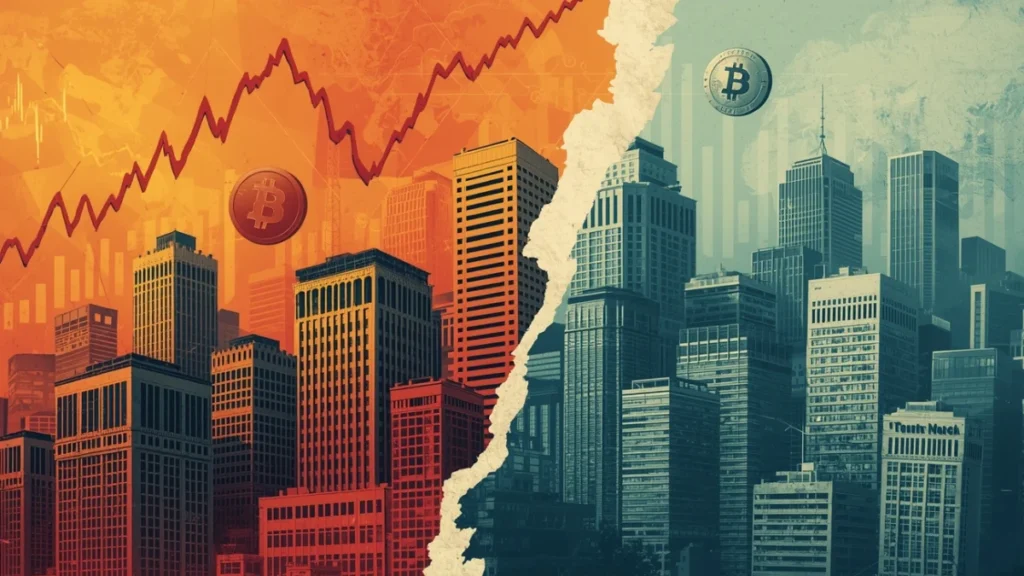
“Stock markets in developed economies have corrected, but the real pain lies ahead. Companies that expanded using cheap debt now face refinancing walls—over $1 trillion in corporate debt matures in the next two years at interest rates three to four times higher than original borrowing costs. Many analysts are now asking: is the global stock market in a bubble?“
Growth stocks and technology companies, which thrived on abundant liquidity and low discount rates, face valuation compressions of 50-80% from 2021 peaks. Cryptocurrencies, the ultimate liquidity-dependent asset class, correlate almost perfectly with global money supply changes.
Even bonds—traditionally safe havens—suffer. The 40-year bull market in fixed income ended violently. Sovereign debt yields surge, prices collapse, and pension funds holding “risk-free” government bonds face massive unrealized losses.
The Corporate and Consumer Consequences
Businesses face a funding winter. Venture capital investment collapsed 60% from peak levels. IPO markets remain largely frozen. Leveraged buyouts, which dominated the 2010s, have virtually ceased. Companies that survived on regular capital injections now scramble for profitability or face bankruptcy.
The startup ecosystem, addicted to growth-at-any-cost funded by cheap capital, faces mass extinction. Tech layoffs exceeded 200,000 in 2023 alone and continue through 2024-2025. The white-collar recession spreads from technology to finance to professional services.
Consumers aren’t spared. Mortgage rates in the U.S. jumped from 3% to over 7%. Credit card debt reaches record levels while delinquency rates rise. Auto loan defaults increase. The cost of everything financed—homes, cars, education—has exploded while wages lag. Global liquidity drying up translates directly to diminished purchasing power and living standards.
What History Teaches About Liquidity Crises
The 2008 financial crisis demonstrated how quickly liquidity can vanish and how devastating the consequences can be. Lehman Brothers collapsed not because it was insolvent but because overnight funding disappeared. Credit markets froze completely. Only unprecedented central bank intervention—the very policies now being reversed—prevented total systemic collapse.
The 1997 Asian Financial Crisis showed how dollar liquidity withdrawal crushes emerging markets. The Thai baht collapsed, contagion spread across Asia, and economies that had grown for decades contracted violently in months.
But this time is structurally different. Global debt levels in 2025 are far higher than 2008—government debt, corporate debt, and household debt all exceed previous peaks as percentages of GDP. Demographic headwinds in developed nations worsen fiscal positions. Geopolitical fragmentation prevents coordinated policy responses. And inflation, absent in previous crises, constrains central banks from immediately reversing course when markets break.
This time is structurally different from 2008. Global debt levels are far higher, inflation constrains central bank response, demographic headwinds worsen fiscal positions, and geopolitical fragmentation prevents coordinated rescue. The playbook that worked in 2008 is not available today.
When Does Liquidity Return? The Four Scenarios
Soft Landing (20% probability): Inflation cools sufficiently for central banks to begin gradual easing in 2026. Growth slows but avoids recession. Markets stabilize at lower valuations. Liquidity returns slowly over years, not months.
Hard Landing (50% probability): Global recession in 2025-2026 forces central banks to pivot aggressively. Emergency liquidity programs return. Markets crash first, then rally on policy reversal. This is the most likely path—pain before relief.
Stagflation Trap (20% probability): Persistent inflation despite weak growth leaves central banks paralyzed. They can’t ease without reigniting inflation, can’t tighten without crushing economies. Liquidity remains tight for years. Asset returns stagnate. This is the worst outcome for investors.
Financial Accident (10% probability): A major bank failure, sovereign default, or market dislocation forces immediate, massive intervention. Systemic risk trumps all other considerations. Liquidity floods back suddenly, but only after significant damage.
The common thread: global liquidity drying up continues until something breaks badly enough to force policy reversal. The only question is what breaks and when.
How to Survive and Thrive in the Liquidity Desert
✅ Liquidity Crisis Survival Checklist
- ✔Raise cash allocation to 15–20% of total portfolio immediately
- ✔Reduce all leveraged positions — liquidity crises punish leverage first
- ✔Shift from growth stocks to dividend-paying defensive sectors
- ✔Keep bond duration under 5 years — interest rate risk is real
- ✔Watch Fed balance sheet weekly — below $7T signals critical stress
- ✔Maintain 3–6 months emergency fund outside all investments
Cash becomes king in low-liquidity environments. Holding higher cash allocations provides flexibility to capitalize on distressed opportunities while protecting against downside volatility. Quality matters more than growth—companies with strong balance sheets, positive cash flow, and low debt survive and eventually thrive.
Dividend-paying stocks in defensive sectors—healthcare, utilities, consumer staples—provide income while growth stocks languish. Geographic diversification remains important, but understand that liquidity crises are now global and correlated. Fixed income requires active duration management—shorter duration bonds reduce interest rate risk.
For businesses, the strategy is simple but brutal: cut costs aggressively, preserve cash, reduce debt, and focus on profitability over growth. Companies that survive the liquidity drought emerge stronger with less competition.
Real assets—commodities, infrastructure, certain real estate—can provide inflation protection and tangible value when financial assets suffer. But leverage kills in tight liquidity environments, so even real assets must be approached carefully.
The Bigger Picture: A New Financial Paradigm
Global liquidity drying up isn’t a temporary blip—it marks the end of an extraordinary 15-year period of monetary experimentation. The consequences extend far beyond investment portfolios.
The geopolitical balance shifts as financial power fragments. The unipolar dollar system evolves toward multipolar regional systems. Globalization reverses toward regionalization. Supply chains shorten. Capital controls become normalized. The free flow of money and goods that characterized 1990-2020 won’t return.
Inflation likely remains structurally higher than the 2010s—not hyperinflation, but persistent 3-5% price growth driven by deglobalization, aging demographics, climate transition costs, and reduced central bank willingness to sacrifice growth for price stability.
This new paradigm rewards different skills and strategies than the previous era. Passive investing in index funds worked brilliantly when liquidity flowed endlessly and all assets rose together. Active management, security selection, and risk management matter again. Geographic and asset class correlations break down, creating opportunities for sophisticated investors.
Conclusion: Adapt or Get Swept Away
The liquidity tide that lifted all boats for 15 years has reversed. Global liquidity drying up will define markets, economies, and investment outcomes for years to come. Central banks engineered the greatest monetary expansion in history, then reversed course with equal aggression. The consequences are still unfolding.

Investors who recognize this structural shift and adjust accordingly will preserve capital and identify opportunities in the chaos. Those who expect a return to easy money conditions will suffer continued disappointment and portfolio damage. Businesses that prioritize profitability, strong balance sheets, and operational efficiency survive. Those dependent on endless capital infusions fail.
The financial system is entering a fundamentally different era. Adaptation isn’t optional—it’s survival. The world has changed. Your strategy must change with it.
🧠 Expert Insights
“Only when the tide goes out do you discover who’s been swimming naked.”
— Warren Buffett
“Cash was trash, now cash is king in a deleveraging world.”
— Ray Dalio
These warnings from legendary investors highlight the reality of global liquidity drying up.
⚠️ Key Risk Indicators to Watch
- Global M2 money supply turning negative
- Fed balance sheet below $7 trillion
- High-yield spreads above 600 basis points
- Emerging market currency index falling 15%+
- Commercial real estate vacancy rates above 20%
- Corporate debt refinancing costs tripling from 2021
📋 Portfolio Review Checklist
- Increase cash allocation to 15–20% of total portfolio
- Review all leveraged positions and reduce exposure
- Shift from growth stocks to dividend-paying quality companies
- Check bond duration — keep under 5 years
- Evaluate emerging market exposure and currency risks
- Ensure 3–6 months emergency fund outside investments
- Diversify across defensive sectors (healthcare, utilities, staples)
- Schedule quarterly portfolio rebalancing reviews
Case Study: Silicon Valley Bank Collapse (March 2023)
SVB’s failure perfectly illustrates how global liquidity drying up destroys overleveraged institutions. The bank invested depositor funds in long-term bonds when rates were near zero. As the Fed hiked rates aggressively, those bonds lost 20-30% of their value. When tech startups (SVB’s main clients) needed cash during the funding winter, deposit withdrawals accelerated. SVB couldn’t meet redemptions without selling bonds at massive losses. Within 48 hours, a bank run wiped out $200 billion in assets. The lesson: liquidity vanishes faster than anyone expects when the tide turns.
Case Study: Evergrande & China’s Property Implosion
China’s $60 trillion property sector collapse shows how debt-fueled growth unravels when liquidity tightens. Evergrande, once China’s largest developer, accumulated over $300 billion in liabilities through cheap credit. When Beijing cracked down on shadow banking and restricted developer financing (the “three red lines” policy), liquidity dried up instantly. Evergrande defaulted, construction halted on millions of unfinished apartments, and contagion spread across the sector. Home prices fell 20-40% in major cities. This deleveraging removed trillions in liquidity from the global system as Chinese capital stopped flowing outward.
What does global liquidity drying up actually mean?
Global liquidity drying up means the total flow of money through the international financial system is shrinking. Central banks are reversing quantitative easing, raising interest rates, and shrinking balance sheets simultaneously. The result is less credit availability, higher borrowing costs, and reduced capital flows — particularly hitting emerging markets and debt-dependent businesses hardest.
How does the Federal Reserve cause a global liquidity crisis?
The US dollar dominates roughly 60% of global reserves and 90% of forex transactions. When the Fed raises rates and conducts quantitative tightening, it drains dollar liquidity from the entire world — not just the US. A stronger dollar makes dollar-denominated debt more expensive for every country, tightens cross-border credit, and forces capital to flow back into the US, away from emerging markets.
Which asset classes are most at risk when liquidity dries up?
Growth stocks and technology companies face valuation compression as discount rates rise. Cryptocurrencies correlate almost perfectly with global money supply and suffer badly. Commercial real estate faces forced deleveraging. Emerging market currencies and sovereign bonds face the most acute risk. Even traditional bonds — long considered safe havens — have suffered as their 40-year bull market ended.
Is a global financial crisis inevitable as liquidity dries up?
Not inevitable — but the probability of a hard landing is significant. The most likely scenario (50% probability) is a global recession in 2025-2026 that forces central banks to reverse course. The key difference from 2008 is that debt levels are now far higher, inflation constrains central bank response, and geopolitical fragmentation prevents coordinated global policy action.
How should investors protect their portfolio when global liquidity is contracting?
In low-liquidity environments, cash allocation should increase to 15-20% of the portfolio. Shift from growth stocks to dividend-paying quality companies in defensive sectors like healthcare, utilities, and consumer staples. Keep bond duration under 5 years. Reduce leveraged positions. Real assets like commodities and infrastructure can provide inflation protection — but avoid leverage even in real assets.
When will global liquidity return to normal?
The most likely path involves a recession or financial accident that forces central banks to pivot and inject liquidity again. Under a hard landing scenario, liquidity begins returning in 2026-2027 — but not to the extreme levels of 2020-2021. Structurally higher inflation, aging demographics, and deglobalization mean the era of endless cheap money is over. A new, tighter normal is the baseline.
Important Disclaimer
This article provides general information and analysis for educational purposes only. It does not constitute financial, investment, legal, or tax advice. Markets are volatile and unpredictable. Past performance does not guarantee future results. Consult qualified financial professionals before making investment decisions. The author assumes no responsibility for financial losses resulting from information presented herein.
About the Author – Abhishek Chouhan
Abhishek Chouhan is a Global Finance Analyst and Market Researcher with over 15 years of experience studying stock markets, investor behavior, and long-term wealth cycles across the US, Europe, and Asia. He is the founder of MoneyUncut.com, a global financial intelligence platform focused on decoding market psychology, economic trends, and how human behavior shapes financial outcomes.
4 comments
Comments are closed.